A companion for reading two books themselves: the Phenomenology of Spirit (1807) and the Science of Logic (1812–16, with the first book revised in 1832). Their history, what to know first, each book chapter by chapter from the first editions, and two centuries of readers.
1807Preface
Diss Werden der Wissenschaft überhaupt, oder des Wissens, ist es, was diese Phänomenologie des Geistes, als der erste Theil des Systems derselben, darstellt.
This coming-to-be of science in general, or of knowing, is what this Phenomenology of Spirit presents, as the first part of the system of science. rendering for this page¶27T1
1812Logic, Preface
sie macht also in einem erweiterten Plane die erste Folge zur Phänomenologie des Geistes aus.
In an enlarged plan, it [the Logic] makes up the first sequel to the Phenomenology of Spirit. rendering for this page 1812 p. XT2
1831note for the 2nd edition
Dieser Titel wird der zweyten Ausgabe, die auf nächste Ostern erscheinen wird, nicht mehr beygegeben werden.
This title will no longer be given to the second edition, which will appear next Easter. rendering for this pageGW 21:9T3
The relation of the two books in Hegel’s own words. In 1807 the Phenomenology is the first part of a “System of Science”. In 1812 the Logic is its “first sequel”. In a footnote to the reprinted 1812 Preface, written for the revised edition of 1832, Hegel says the title “first part of the System of Science” will be dropped from the planned second edition of the Phenomenology (✱5, ✱6).
Bands are sized by how much happened in them; inside each band, spacing follows the dates. Select a dot, then use the ← and → keys to step. Every event is sourced in the chapter it links to.
Contents
What this site is
This is a study companion, not a summary. It is meant to sit next to the two books and help a reader get through them: where they came from, what to know before starting, and, chapter by chapter, what Hegel says, where he says it, and how readers have disagreed about what he says. The hub you are on covers Hegel’s life and works, the background, a glossary of nineteen terms, reading orders and a map of the links between the two books. The Phenomenology page and the Logic page take each book in Hegel’s own order. The Readers page follows the schools that formed around the books and the uses made of them outside the scholarship.
How to read this site
Every claim carries a small letter for the kind of source it rests on, followed by numbered references:
TText: what Hegel says in the Phenomenology or the Science of Logic, with the location.
LLetters and other works: a letter, the Encyclopaedia (Hegel’s own paragraphs and Remarks), a Jena writing.
EEditor-compiled: lecture courses printed from students’ notes and the Zusätze (additions) that the editors of the 1832–45 Werke attached to the Encyclopaedia. They are evidence about Hegel’s teaching, not his own text, and the sentence names the editor.
HHistory: a document of the time or a scholarly biography.
IInterpretation: a named commentator, with the work and page in the sentence.
Where readers disagree, their readings stand side by side in a box headed Readers disagree, and this site does not pick a winner. Worked examples are Hegel’s own unless marked Illustration. References are numbered once for the whole site; each page lists the ones it uses, and the full list gives every source with a badge, P for primary and S for secondary, and the chapters that use it.
Locations. The Phenomenology is cited by paragraph in A. V. Miller’s numbering, ¶1–808, with the page of the 1807 edition and of the critical edition, Gesammelte Werke vol. 9 (GW 9).H4,5 The Science of Logic is cited by GW volume and page: GW 21 for the 1832 Doctrine of Being, GW 11 for the 1812 Doctrine of Being and the 1813 Doctrine of Essence, GW 12 for the 1816 Doctrine of the Concept; passages of the 1812 Doctrine of Being are also given by the page of the 1812 print.T2,6,7,8 Every such location is a link: select it and the structure explorer on that book’s page opens there.
Quotations. German is quoted from the first printings: the 1807 Phenomenology and the 1812 Doctrine of Being as transcribed by the Deutsches Textarchiv, and the 1813 and 1816 books and the 1832 Doctrine of Being as transcribed by the Digitale Hegel-Edition from the Gesammelte Werke (for 1813 and 1816, checked against the Textarchiv’s transcriptions of the prints), keeping their spelling (Seyn, diß, Bewußtseyn) but printing the long s as s and the small superscript e as an umlaut.T1,3 Every German quotation from the two books has been checked by script against those transcriptions; quotations from other documents (letters, Marx, Strauss) are marked with their sources. English comes from translations in the public domain: J. B. Baillie’s Phenomenology of Mind (1910; Baillie died in 1940) and William Wallace’s translation of the Encyclopaedia Logic (2nd ed., 1892).H9,10,11 Any other English in a quotation block is our own and is labelled rendering for this page; short translations of single words and phrases in the running text are also ours. The 1929 translation of the Science of Logic by W. H. Johnston and L. G. Struthers is public domain in the United States but not in the United Kingdom or the European Union, where it remains protected until at least the end of 2049 (Leslie Graham Struthers died in 1979; W. H. Johnston’s dates are not known), so it is cited here by volume and page only.H12,13 Modern translations (Miller, Pinkard, di Giovanni and others) are cited by location and never quoted.
Part A · 1770–1845
Life and works
Where the two books came from: a seminary in Tübingen, tutoring posts, a university town occupied by Napoleon’s army, a school in Nuremberg, two professorships, and the revisions Hegel left unfinished at his death.
✱1Stuttgart, Tübingen, Bern, Frankfurt, 1770–1800
Life and works, part 1 · the Stift, the Revolution, two tutorships, manuscripts Hegel kept to himself
Tübingen
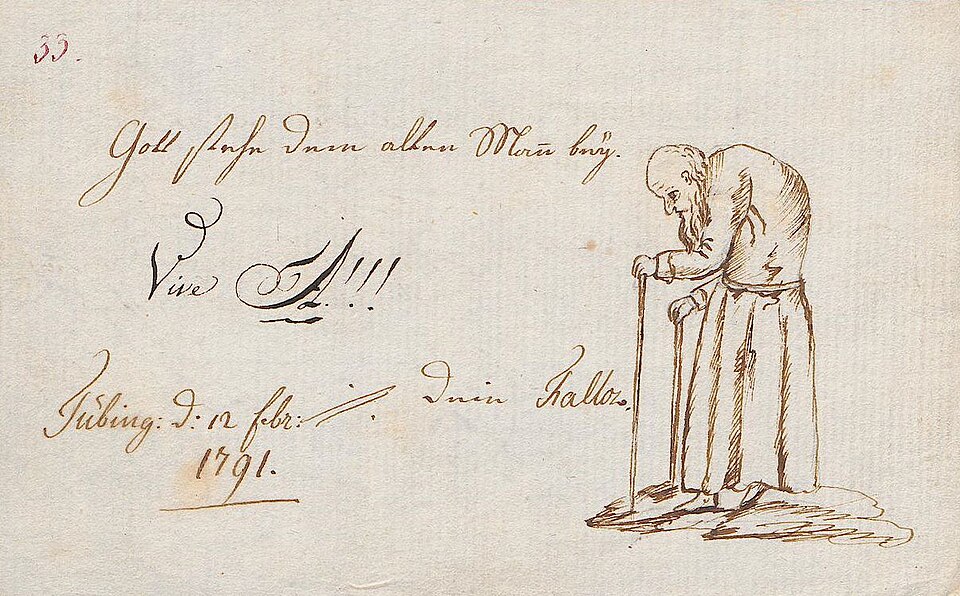
Georg Wilhelm Friedrich Hegel was born in Stuttgart, in the Duchy of Württemberg, on 27 August 1770.H14,15 From 1788 to 1793 he studied at the Protestant seminary in Tübingen, the Stift: first the two-year philosophy course, ending with a master's dissertation in 1790, then theology. His leaving certificate of 1793, as Britannica reports it, rated his theological work as intermittent.H14,16 His fellow students nicknamed him "the old man".H14
According to a Tübingen exhibition, in autumn 1790 Hegel, Hölderlin and Schelling moved, with seven other scholarship students, into one of the heated "winter rooms" of the Stift; it bases this on Hölderlin's letter to his sister of 16 November 1790.H17 Karl Rosenkranz, whose biography of 1844 prints many of Hegel's letters and manuscripts, was more cautious: he wrote that there were not even secure and consistent reports about which room Hegel lived in.H16
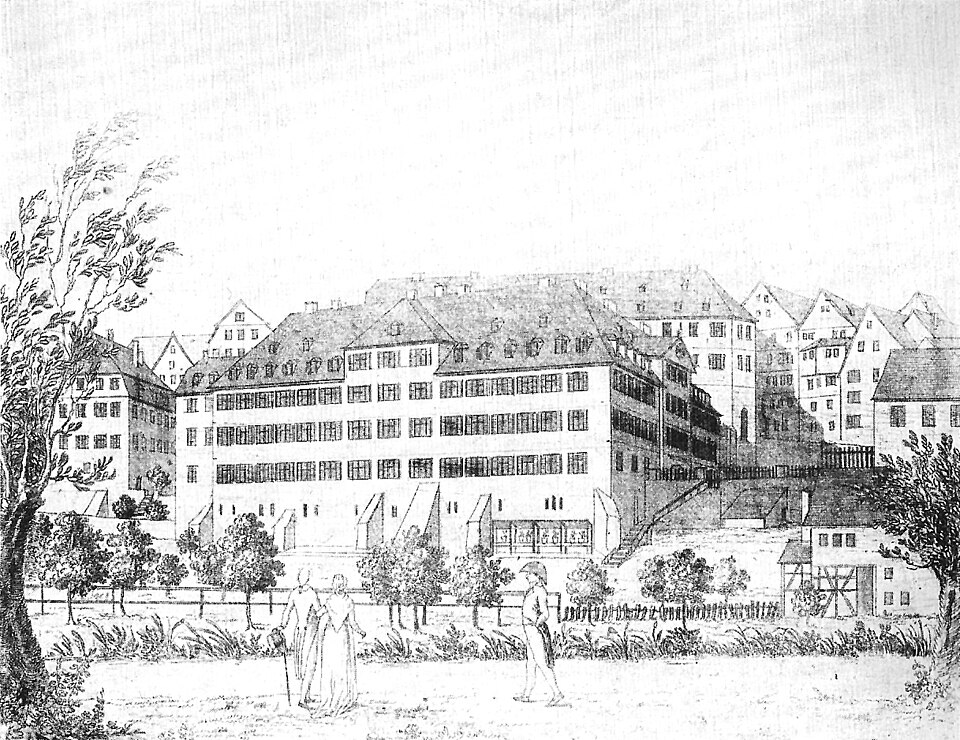
The Protestant Stift in Tübingen from the south, etching by J. C. Partzschefeldt, 1802. Johann Christian Partzschefeldt. Public domain; Wikimedia Commons. Source: Stadtmuseum Tübingen, inv. 3163 (via C. Melk, Tübinger Ansichten, 1986, p. 21).“Gott stehe dem alten Mann bey”: caricature of the student Hegel by Fallot in Hegel's album, 12 February 1791. Fallot. Public domain; Wikimedia Commons. Source: Hegel's album amicorum (Stammbuch), 1791–1794, fol. 33r, Universitätsbibliothek Tübingen, Mh 858.
The French Revolution
The three friends took up the Revolution in France with enthusiasm.H14,17 The exhibition marks as confirmed a political club in which Stift students exchanged news from France, and reports that Hegel's album (Stammbuch) speaks of secret political meetings.H17 Rosenkranz says that the Revolution became a main element of the students' social life, and adds:H16
Für das Aechte und Große in der Französischen Revolution hat Hegel von dieser Zeit ab stets eine zärtliche Verehrung …
For what was genuine and great in the French Revolution Hegel from that time on always had a tender reverence … rendering for this page
Rosenkranz 1844, chapter "Die Universität Tübingen" (archive.org scan, leaf 71; machine reading, not yet checked against the page image)
In 1807 the Revolution has its own section in the Phenomenology, "Die absolute Freyheit und der Schrecken" (Absolute freedom and terror, ¶582–595).T
What we know and what is legend
One story is told again and again: on 14 July 1793 Hegel, Hölderlin and Schelling set up a liberty tree on the Tübingen market square and danced round it. The Tübingen exhibition lists it among "Tübingen rumours" and classes it as legend; it gives no source.H17 Rosenkranz seems not to tell it: a full-text search of his book for "Baum" (tree) finds nothing in the Tübingen chapter. The scan's text is machine-read, so this is evidence of absence, not proof.H16 The earliest printed source of the story has not been found.
Claim
What the sources say
A shared room from autumn 1790
Stated by the exhibition from Hölderlin's letter; Rosenkranz (1844) knew of no secure reports about Hegel's room.H16,17
A political club in the Stift
"Confirmed" for the exhibition. W. G. Jacobs's archival study of the Stift (1989) questions the received picture of a Jacobin club and of revolutionary reading; we have seen only the publisher's description.H17I18
The liberty tree, 14 July 1793
Legend for the exhibition; apparently not in Rosenkranz; no early source found.H16,17
Books of the decade
The philosophy the students read was new. Kant's Critique of Pure Reason had appeared in 1781 (second edition 1787), the Critique of Practical Reason in 1788, the Critique of the Power of Judgment in 1790.H19 Jacobi's letters on Spinoza (1785; second edition 1789) had started the "Pantheism controversy" with Mendelssohn, a story told from the Spinoza side on the Spinoza page.H20 Fichte's Grundlage der gesammten Wissenschaftslehre came out in parts in 1794 and 1795.H21
Bern, 1793–1796
After his consistorial examination in 1793 Hegel became house tutor (Hauslehrer) to the family of Steiger von Tschugg in Bern, until autumn 1796. Rosenkranz says that nothing more precise is known about the post.H16 A letter to Schelling of 30 August 1795 is dated from "Tschugg bei Erlach über Bern".L22
Frankfurt, 1797–1800
Hölderlin found Hegel a new tutorship in Frankfurt am Main. In January 1797 he joined the house of the merchant Gogel, who lived on the Roßmarkt.H14,16 His father died in 1799 and left him an inheritance that let him give up tutoring.H14,16 In January 1801 he went to Jena (✱2).H14
Manuscripts, not books
In Bern and Frankfurt Hegel wrote long manuscripts on religion, now called the "early theological writings". He never published them. Rosenkranz printed extracts in 1844; the first collected edition was Herman Nohl's Hegels theologische Jugendschriften (Tübingen: J. C. B. Mohr, 1907).H16,23 So "the young Hegel" of later debates speaks through drafts he did not release, gathered under an editor's title.
✱2Jena, 1801–1807: Schelling, Napoleon and the Phenomenology
Life and works, part 2 · the writing, printing and titles of the 1807 book
With Schelling in Jena
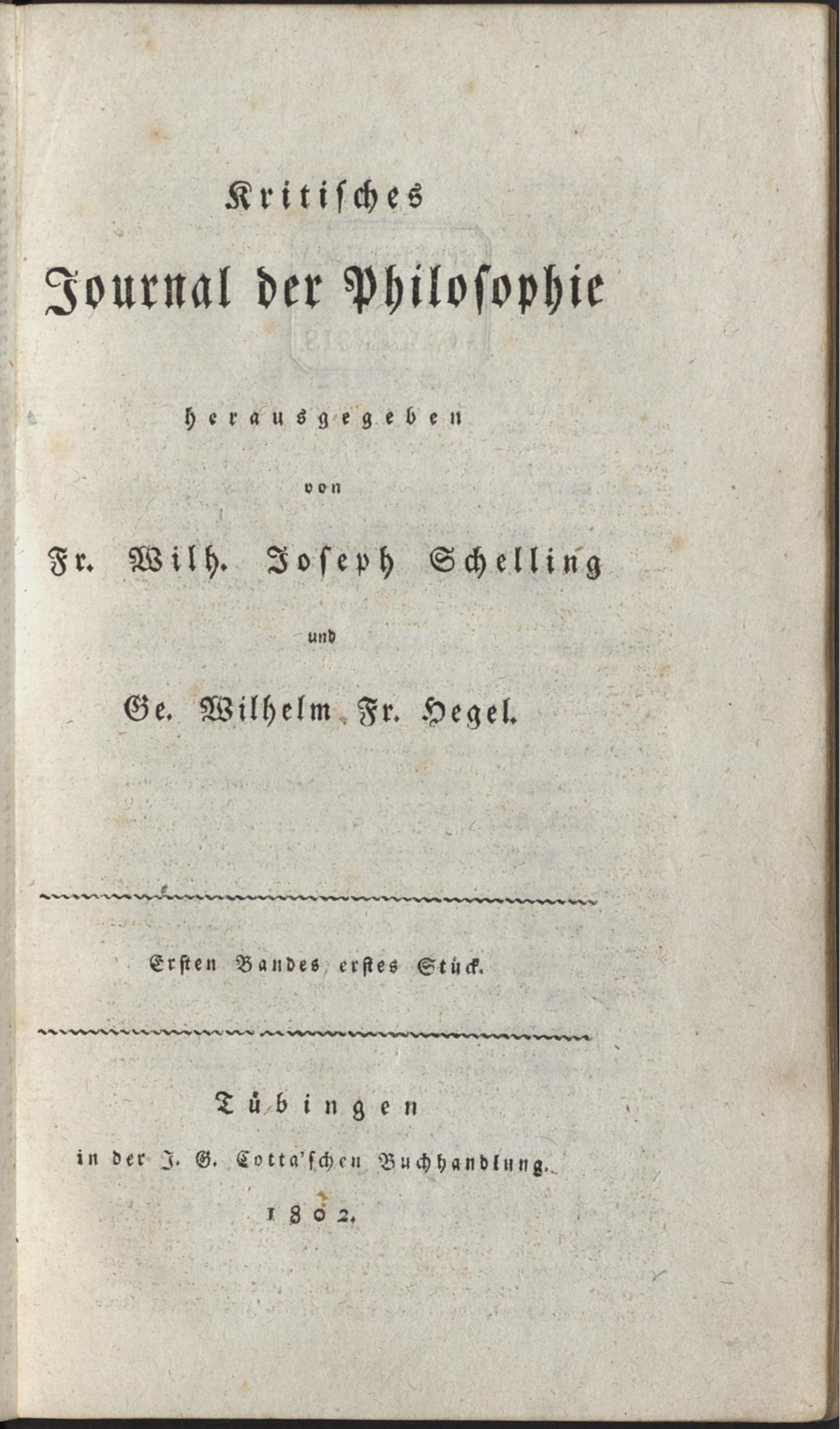
Hegel arrived in Jena in January 1801; Schelling had been professor there since 1798.H14 That year Hegel published his first philosophical book, Differenz des Fichte'schen und Schelling'schen Systems der Philosophie, the "Differenzschrift".L14,16 As an unsalaried lecturer (Privatdozent) he taught from winter 1801–02. He became extraordinary professor in February 1805 and drew a first stipend of 100 thalers in July 1806, through Goethe.H14 In 1802–1803 he and Schelling edited the Kritisches Journal der Philosophie, which gave Hegel a lasting reputation as Schelling's follower.H15,16
Title page of the Kritisches Journal der Philosophie, edited by Schelling and Hegel (1802). Schelling and Hegel (editors). Public domain; Wikimedia Commons. Source: books.google.com scan.
A book written against a deadline
The lecture announcement for winter 1806/07 names a "Phaenomenologia mentis" as a preliminary part of the system. Jaeschke notes that this is its only such mention, and that issuing the work on its title page as the first part of the system itself was a later decision (2009, pp. 20–21).I24 Rosenkranz reports a deadline (Präclusivtermin) agreed with the bookseller for delivery of the manuscript.H16 According to Rosenkranz, Gans's obituary said that Hegel finished the book "unter dem Donner der Kanonen der Schlacht von Jena", under the thunder of the guns at the battle of Jena. Rosenkranz corrects him: this is true only in so far as Hegel was about to send off the last sheets.H16,25 On 13 October 1806 Hegel was still worrying about the manuscript he had posted "last Wednesday and Friday".L16
13 October 1806
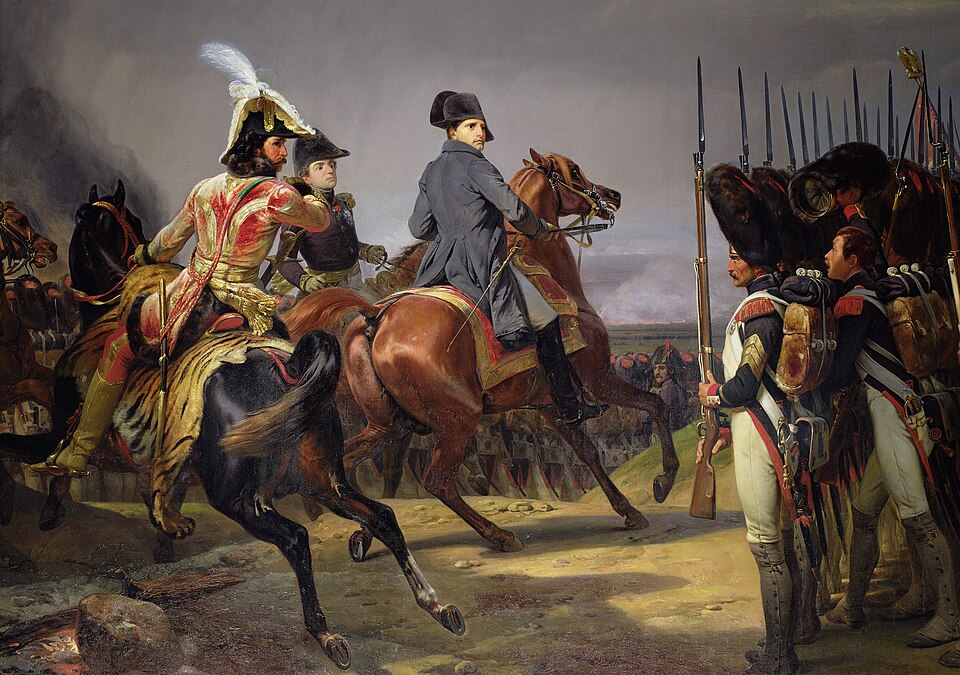
Rosenkranz prints the letter Hegel wrote to his friend Niethammer "still before the battle", dated Jena, Monday 13 October 1806, the day Jena was occupied by the French.L16 The battle of Jena and Auerstedt was fought the next day, 14 October 1806.H26
Den Kaiser — diese Weltseele — sah ich durch die Stadt zum Recognosciren hinausreiten. — Es ist in der That eine wunderbare Empfindung, ein solches Individuum zu sehen, das hier, auf Einen Punct concentrirt, auf einem Pferde sitzend, über die Welt übergreift und sie beherrscht.
The Emperor – this world-soul – I saw riding out through the city to reconnoitre. – It is indeed a wonderful feeling to see such an individual, who here, concentrated at one point, sitting on a horse, reaches out over the world and masters it. rendering for this page
Hegel to Niethammer, 13 October 1806, as printed in Rosenkranz 1844, p. 229 (two machine readings agree; not yet checked against the page image)
The word is Weltseele, world-soul, not Weltgeist, world-spirit, as it is often misquoted; Sandkaulen stresses the point (2009, p. 10).I27 When the French forced their way into the town and began to plunder houses, Hegel held out in his lodgings for a while; after the battle Napoleon had the spreading fire checked. After the plundering, Rosenkranz says, Hegel had literally not a penny and turned to Niethammer, not knowing whether his manuscript had arrived.H16
The Battle of Jena, 14 October 1806, painted by Horace Vernet in 1836. Horace Vernet. Public domain; Wikimedia Commons. Source: kunst für alle; 1000Museums.
Title pages
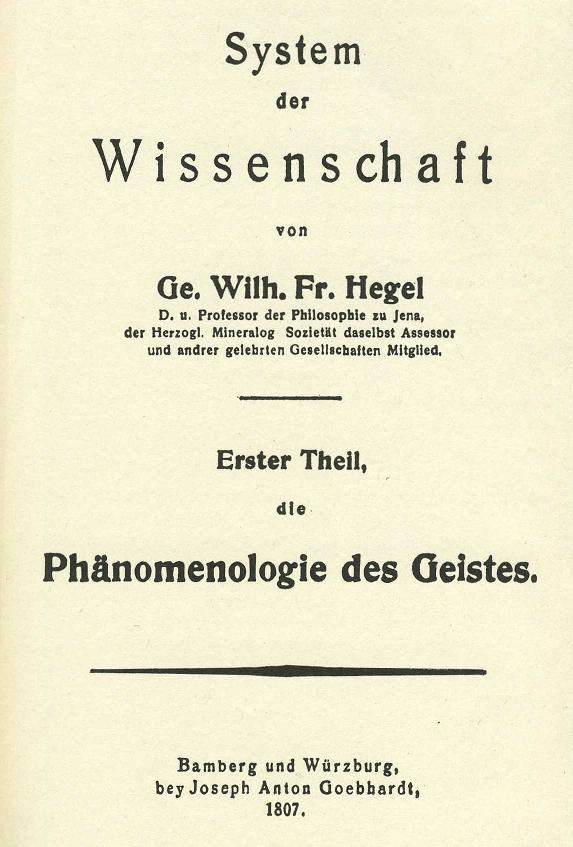
Title page of the first edition: System der Wissenschaft. Erster Theil, die Phänomenologie des Geistes (Bamberg und Würzburg: Goebhardt, 1807). original uploader Nihil Kainer (de.wikipedia). Public domain; Wikimedia Commons. Source: Transferred from de.wikipedia to Commons; scan source not stated.
The book appeared as System der Wissenschaft. Erster Theil, die Phänomenologie des Geistes (Bamberg and Würzburg: Joseph Anton Goebhardt, 1807), the title as the Deutsches Textarchiv records it; the exact punctuation of the title page is unchecked.H1 The month is uncertain: March (Sandkaulen et al. 2009, p. 9), spring (Hoffmann 2009, p. 11), or April in a bookseller's description.H25,27,28
In the copy the Textarchiv transcribed, a leaf after the Preface (after 1807 p. XCI) carries an intermediate title: Erster Theil. Wissenschaft der Erfahrung des Bewusstseyns, "First part. Science of the experience of consciousness".T1 The Introduction gives the road it describes the same name:
Durch diese Nothwendigkeit ist dieser Weg zur Wissenschaft selbst schon Wissenschaft, und nach ihrem Inhalte hiemit Wissenschafft der Erfahrung des Bewusstseyns.
Through this necessity this way to science is itself already science, and by its content therefore science of the experience of consciousness. rendering for this page
Jaeschke writes that the intermediate title was later removed on Hegel's instruction (2009, p. 22).I24 López reports that Hegel had it replaced during printing by "Wissenschaft der Phänomenologie des Geistes", so copies differ (2015, citing Hoffmeister 1937, p. XXXVIII).I29
Readers disagree
The readers below accept that the plan changed while Hegel was writing; was the change a break, or does the finished book still have a unified design, and does the change of title record it?
Haering (1934); Rendón (2008)
As Rendón reports him (2008, pp. 44–45): no long-planned design, but a sudden decision under pressure, fast writing and an intention that changed. Rendón calls the change a conscious transformation, not a break.I30
Pöggeler (1966)
As López reports, the work's conception evolved during composition.I29,31
Stewart (2020)
Grants "compelling philological evidence" (pp. 386–387) that the first plan covered only Consciousness, Self-consciousness and Reason, yet argues (1995, 2000) that the finished book is a unified whole.I32
Forster (1998)
Part IV of his book accepts a shift in plan and argues about its reasons and its effects on the design (table of contents).I33
Schelling's reaction and the end of a friendship
The Preface mocks an Absolute in which everything is one:
… oder sein Absolutes für die Nacht auszugeben, worin, wie man zu sagen pflegt, alle Kühe schwarz sind; ist die Naivität der Leere an Erkenntniss.
… or to pass off one's Absolute as the night in which, as they say, all cows are black, is the naivety of emptiness in knowledge. rendering for this page
Hegel names no one in ¶16, and a search of the whole 1807 text finds no "Schelling".T He sent the book to Schelling with a letter of 1 May 1807.L34 Schelling replied on 2 November 1807. He had read only the Preface; he did not yet understand why Hegel opposed the concept (Begriff) to intuition (Anschauung); and, in Buchheim's quotation, "versöhnen läßt sich freilich Alles, Eines ausgenommen", everything can be reconciled except one thing (Buchheim 2003, p. 306).L34 Hegel never answered, and the correspondence dried up (pp. 306, 313).H34 Redding's SEP entry says Schelling read a critical passage of the Preface as aimed at him and the friendship ended.I15
Yes: despite Hegel's denials, the Preface targets Schelling's programme of 1806, not only his imitators (abstract; p. 307).I34
Vater (1987)
Against Harris's "The Cows in the Dark Night" (1987), which applies the attack on formalism to Schelling: the "formalism" is a loose mix of Fichte, Schelling, Reinhold and Bardili.I35,36
Bowie (SEP)
The passage is often taken as a critique of Schelling's identity philosophy; as a reading of Schelling's argument that is not valid (§3).I37
✱3Bamberg and Nuremberg, 1807–1816: the Science of Logic
Life and works, part 3 · newspaper editor, headmaster · Wissenschaft der Logik 1812, 1813, 1816
A newspaper in Bamberg
From 1807 to 1808 Hegel edited a daily paper, the Bamberger Zeitung. The post came through his friend Niethammer.H14,16 Fetscher's NDB article (1969) says Hegel left Jena in March 1807, because falling student numbers no longer gave him enough income.H38 William Wallace, who translated the Encyclopaedia Logic, called the job "a stop-gap and pot-boiler" (Wallace 1892, Bibliographical Notice).I10 Niethammer, Wallace goes on, held an important post in the Bavarian education office and asked Hegel whether he would write a logic for school use and become rector of a grammar school. Hegel, already at work on his larger Logic, was only half-attracted.H10 Wallace translates his reply:
The traditional Logic … is a subject on which there are text-books enough, but at the same time it is one which can by no means remain as it is: it is a thing nobody can make anything of: 'tis dragged along like an old heirloom, only because a substitute—of which the want is universally felt—is not yet in existence.
Hegel to Niethammer, in Wallace's translation (Wallace 1892, Bibliographical Notice; Wallace cites Hegel's Briefe i. 172)
Rector in Nuremberg
In December 1808 Hegel became rector, that is headmaster, of the Aegidiengymnasium in Nuremberg, where he also taught philosophy. The sources differ on the end: Britannica gives August 1816, the SEP entry 1815.H14,15,16 Wallace, drawing on the letters, describes the post as no sinecure: the rector was to introduce his pupils to speculative thought "by graduated exercises", in four hours a week, and Hegel doubted that it could be done.H10 To an old college friend he described himself as "a schoolmaster who has to teach philosophy" (Wallace's translation).L10
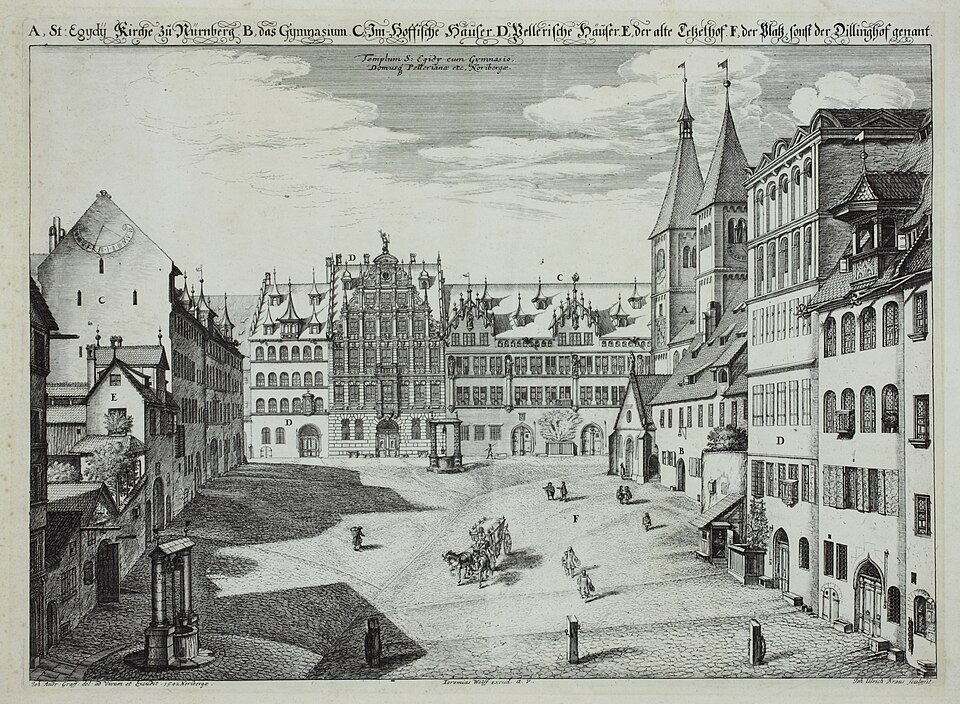
The Egidienplatz in Nuremberg, copper engraving by J. A. Graff, 1682, more than a century before Hegel was rector of the gymnasium there. Johann Andreas Graff. CC0 (work public domain); Wikimedia Commons. Source: Museen der Stadt Nürnberg, Kunstsammlungen.
In 1811 Hegel married Marie von Tucher, from one of the oldest Nuremberg patrician families and 22 years younger than he. Their sons were Karl, later a historian and the editor of Hegel's letters (1887), and Immanuel.H14,16 Rosenkranz dates the wedding to 16 September 1811 (1844, p. 265).H16 Ludwig, Hegel's son born outside marriage in his Jena years, later joined the family.H14
The school courses were never published by Hegel. The text called the "Philosophical Propaedeutic" was compiled by the editor Karl Rosenkranz, from manuscripts and pupils' dictations, for vol. 18 of the collected Werke, Philosophische Propädeutik (1840); the critical edition is GW 10, edited by Klaus Grotsch (2006). It is an editor's text, not a book of Hegel's.E39,40,41
Three volumes, 1812–1816
The first book of the Wissenschaft der Logik, the Doctrine of Being, appeared at Nuremberg with Johann Leonhard Schrag in 1812.T2 Its Preface ends with the plan of the whole and a date:
Dieser erste Band der Logik aber enthält als erstes Buch die Lehre vom Seyn; das zweyte Buch, die Lehre vom Wesen, als zweyte Abtheilung des ersten Bands, ist bereits unter der Presse; der zweyte Band aber wird die subjective Logik, oder die Lehre vom Begriff enthalten. … Nürnberg, den 22. März 1812.
This first volume of the Logic contains as its first book the Doctrine of Being; the second book, the Doctrine of Essence, as the second part of the first volume, is already in the press; the second volume will contain the subjective logic, or the Doctrine of the Concept. … Nuremberg, 22 March 1812. rendering for this page
Doctrine of Being, 1st ed. (1812), Preface · 1812 p. X (GW 11:8)
The Doctrine of Essence followed in 1813, and the second volume, the subjective logic or Doctrine of the Concept, in 1816.T42,43 The preliminary note (Vorbericht) of 1816 is dated "Nürnberg den 21. Jul. 1816" (GW 12:6).T43 In it Hegel compares his task with town planning. For the earlier books he had found few predecessors; for the logic of the concept the material is "ossified" (verknöchert) and must be made fluid again, as when one gives a new plan to an old, solidly built city that people still live in (GW 12:5).T43 He also asks for indulgence:
daß meine Amts-Verhältnisse und andere persönliche Umstände mir nur eine zerstreute Arbeit in einer Wissenschaft gestatteten, welche einer unzerstreuten und ungetheilten Anstrengung bedarf und würdig ist.
that my official duties and other personal circumstances allowed me only scattered work in a science that needs, and deserves, undistracted and undivided effort. rendering for this page
Doctrine of the Concept (1816), Vorbericht · GW 12:6
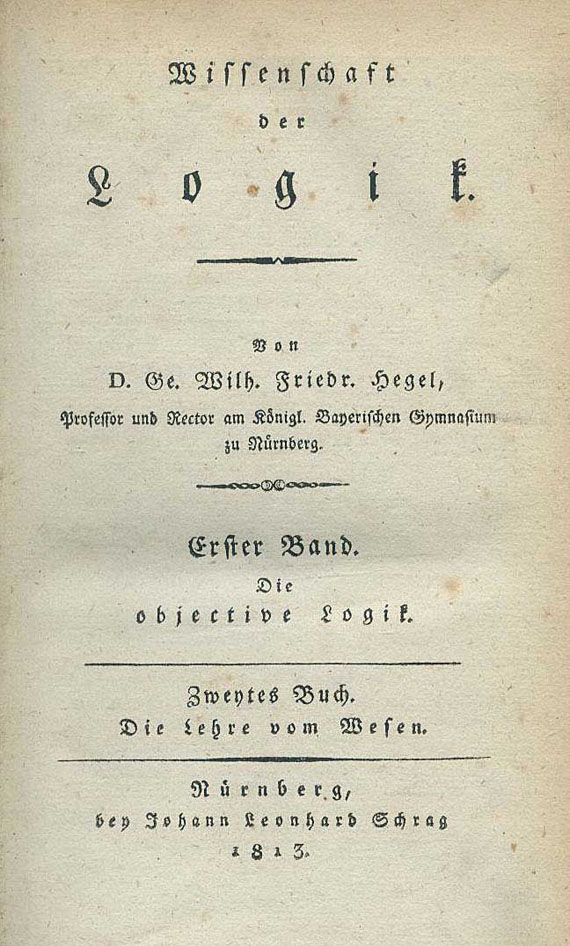
Title page of the Doctrine of Essence: Wissenschaft der Logik … Erster Band. Die objective Logik. Zweytes Buch. Die Lehre vom Wesen (Nürnberg: Schrag, 1813); Hegel is styled professor and rector of the royal Bavarian Gymnasium at Nuremberg. Hegel (title page). Public domain; Wikimedia Commons. Source: Ketterer Kunst auction listing (kettererkunst.de, obnr 411502505).
The Logic and the Phenomenology in 1812
The 1812 Preface places the new work inside the plan of 1807. The Phenomenology had been the first part of a "System of Science"; a second part was to contain the Logic and the two "real" sciences, of nature and of spirit. The Logic had grown too long and now appeared on its own, as "the first sequel to the Phenomenology of Spirit in an expanded plan" (1812 Preface p. X, GW 11:8).T2 The 1812 Introduction calls the Phenomenology the "deduction" of the concept of pure science (1812 Introduction p. XII, GW 11:20).T2 What these words mean, and what became of the plan, is the subject of ✱6. In 1831 Hegel wrote that the Encyclopaedia, first published at Heidelberg in 1817, had taken the place of that second part (GW 21:9; see ✱4).T3
✱4Heidelberg and Berlin, 1816–1831: the Encyclopaedia
Life and works, part 4 · Encyclopaedia 1817, 1827, 1830 · Philosophy of Right · the lectures
Four books
Wallace, in 1892, counted four works that Hegel published as books: the Phenomenology (1807), the Science of Logic (1812–16), the Encyclopaedia, and the Philosophy of Right. Besides these, he says, there are only essays, addresses and reviews; he leaves aside the Differenzschrift of 1801 (✱2).H10 This chapter covers the last two, and the lectures that others turned into books.
Heidelberg, 1816–1818
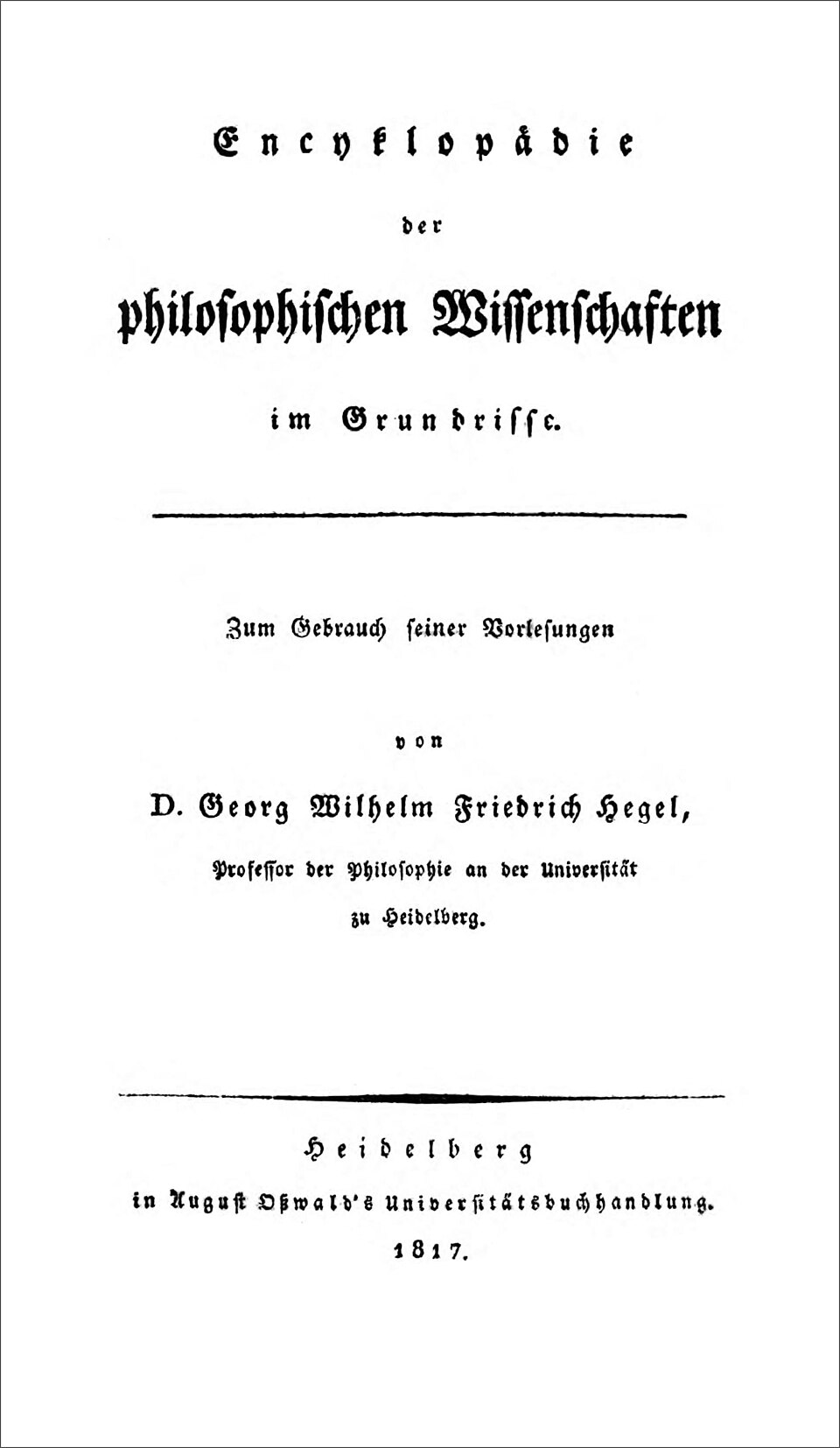
In autumn 1816 Hegel became professor of philosophy at Heidelberg.H10,14 In 1817 the first edition of the Encyklopädie der philosophischen Wissenschaften im Grundrisse appeared there, a thin octavo of xvi + 288 pages: Logic pp. 1–126 (with 12 pages of Introduction and 18 of "Preliminary Notion", Vorbegriff), Philosophy of Nature pp. 127–204, Philosophy of Spirit pp. 205–288.H10 It was an outline for his lecture courses. The Preface promises, in Wallace's translation:
a new treatment of philosophy on a method which will, as I hope, yet be recognised as the only genuine method identical with the content.
Encyclopaedia, 1st ed. (1817), Preface p. iv, as translated in Wallace 1892, Bibliographical Notice
Hegel also took part in the Heidelberger Jahrbücher.H16
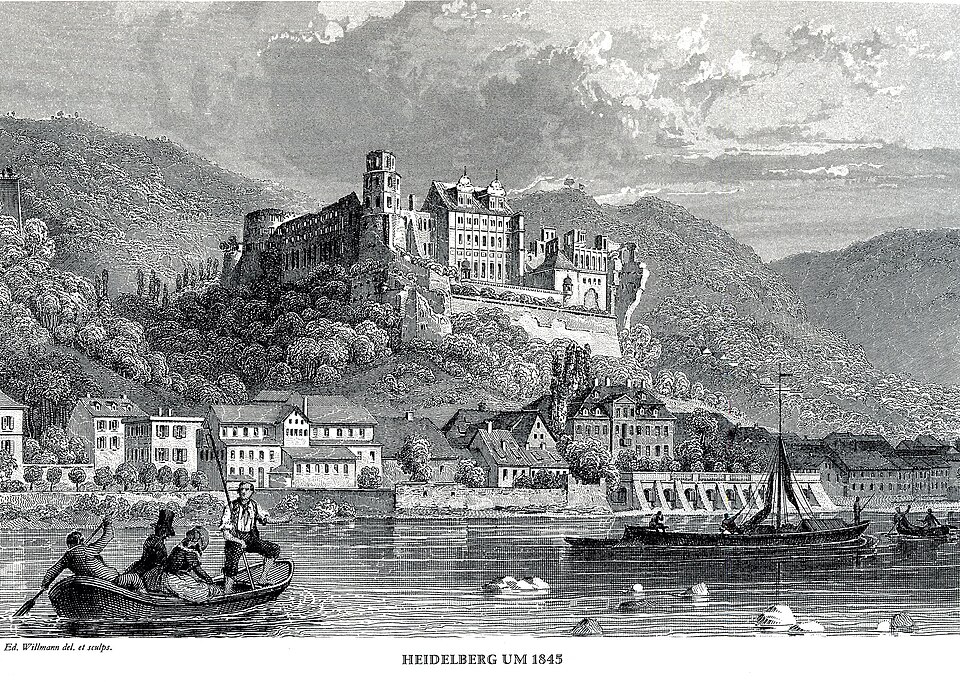
Title page of the Encyclopaedia of the Philosophical Sciences in Outline (Heidelberg, 1817). Hegel (title page). Public domain; Wikimedia Commons. Source: digitale-sammlungen.de (Bayerische Staatsbibliothek).Heidelberg with the castle, steel engraving after Eduard Willmann, c. 1845. drawn by Eduard Willmann (steel engraving). Public domain; Wikimedia Commons. Source: Archiv “Deutschland und die Welt”.
The system in three parts
The Encyclopaedia sets out the whole system in outline: Logic, Philosophy of Nature, Philosophy of Spirit.H10 That is the "second part" announced in 1807 and again in 1812 (✱3), now published in one volume. Hegel says so himself in 1831: the Encyclopaedia took the place of the planned second part (GW 21:9; see ✱5).T3
The name of the 1807 book survives inside the system. In the Philosophy of Spirit, between Anthropology and Psychology, stands a short section called "Die Phänomenologie des Geistes. Das Bewußtseyn" (GW 20 table of contents, GW 20:421).L44 In 1830 it runs from §413 to §439 and treats consciousness, self-consciousness and reason. Its subheadings echo chapters I–V of 1807 by name; the chapters on Spirit and Religion have no counterpart there.L45 How the two phenomenologies relate is discussed in ✱6.
Berlin, 1818–1831
In 1818 Hegel accepted the chair of philosophy at Berlin, vacant since Fichte's death in January 1814.H14,21 The Grundlinien der Philosophie des Rechts followed; its title page bears the date 1821, while Wallace gives 1820.L10,14 The title page reads "Berlin, 1821", and the Preface is dated "Berlin, den 25. Juni 1820".L46 David James, in the introduction to his Critical Guide (2017), writes that the book seems in fact to have come out in 1820.I47 Wallace describes the Berlin years as a time of political supervision of universities after the Carlsbad decrees of 1819, with Hegel's theology suspected by rationalists and evangelicals alike.H10 Hegel was rector of the university and in that office presided over the celebration of the Augsburg Confession in 1830.H14,16
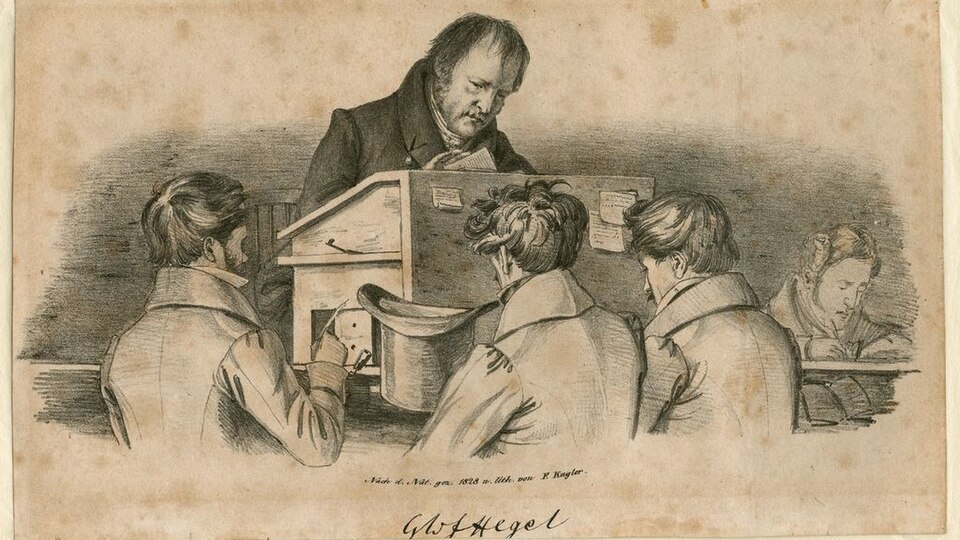
Hegel lecturing to students, lithograph by Franz Kugler, 1828. Franz Kugler. Public domain; Wikimedia Commons. Source: reproduced in Das Wissen des 20. Jahrhunderts (Rheda, 1931).
Second and third editions
The second edition of the Encyclopaedia appeared in 1827, with xlii + 534 pages, nearly twice the first. Hegel sent the manuscript from Berlin to Heidelberg from August 1826 onwards, and his friend Daub saw the proofs.H10 In the Logic most of the growth came in the introductory chapters, where 96 pages replaced 30; the new edition set out three "attitudes of thought to objectivity".H10 Hegel was not content. Wallace translates his letter:
To the Introduction … I have given perhaps too great an amplitude … the main fault is not mended—to do which would require me to limit the detail more, and on the other hand make the whole more surveyable, so that the contents should better answer the title of an Encyclopaedia.
Hegel on the second edition, as translated in Wallace 1892, Bibliographical Notice (Wallace cites Hegel's Briefe ii. 204)
The third edition appeared in 1830, with lviii + 600 pages; Wallace notes that the concrete parts gained most.H10 This site cites the Encyclopaedia by the § numbers of 1830. Its §25 Remark looks back on the Phenomenology (✱6).L10
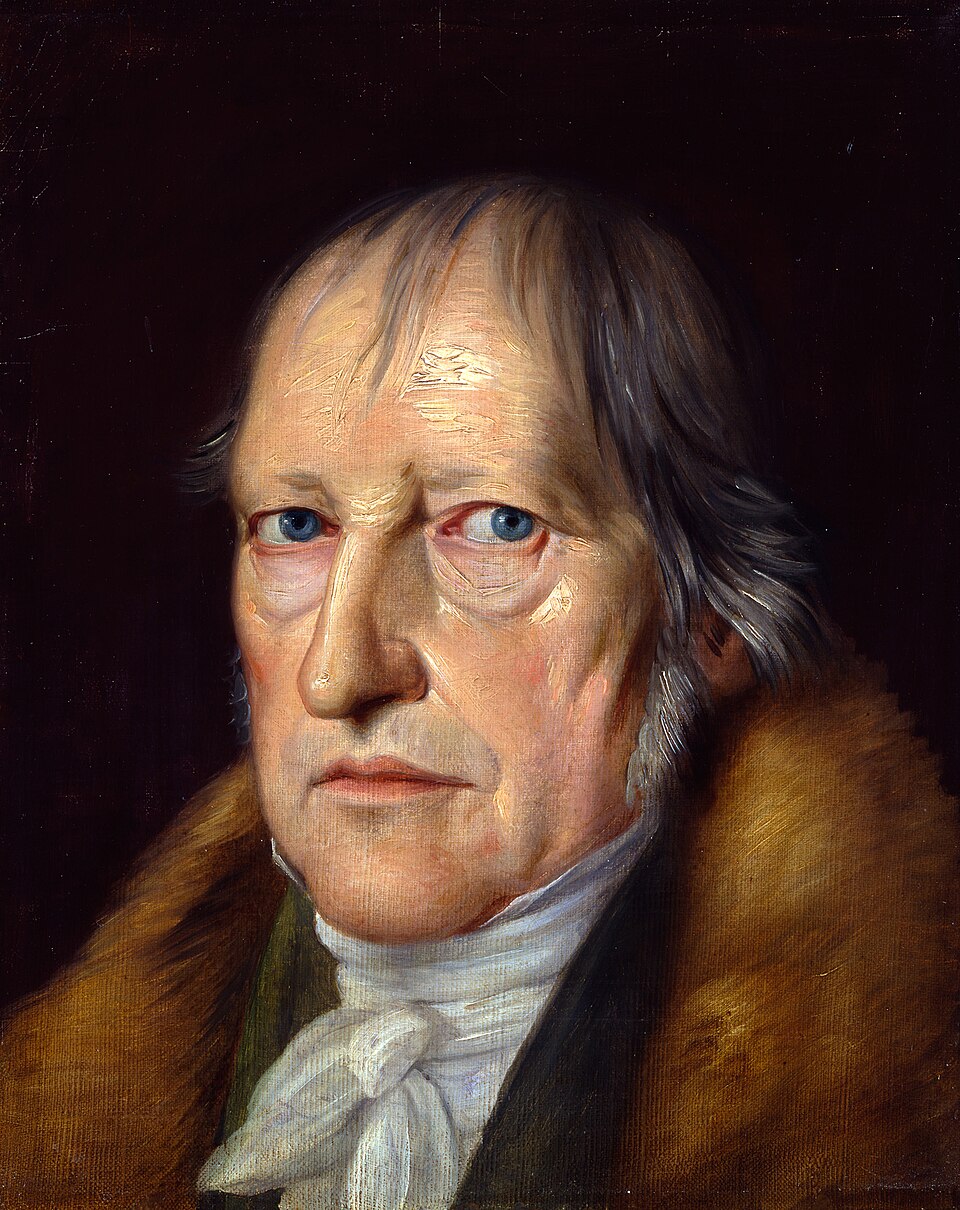
Hegel in 1831, portrait by Jakob Schlesinger (Alte Nationalgalerie, Berlin). Jakob Schlesinger (1792–1855). Public domain; Wikimedia Commons. Source: Alte Nationalgalerie, Berlin (recherche.smb.museum/detail/963803).
The lectures
Much of what readers know as Hegel's philosophy of history, of art, of religion and his history of philosophy comes from Berlin lecture courses that he did not publish. In the collected Werke these fill vols. IX–XV, in which, as Wallace puts it, "his editors have given" the lectures.H10 The English Lectures on the History of Philosophy of Haldane and Simson, for instance, translate the edition compiled by Michelet.E48 Such texts are editor-compiled; on this site they are always marked as such (✱5).
✱51831–1845: the revised Doctrine of Being, the plans for the Phenomenology, the Werke
Life and works, part 5 · Preface of 7 November 1831 · Hegel's death · the note at GW 21:9 · the friends' edition, 1832–1845
The last preface
In 1831 Hegel revised the first book of the Logic, the Doctrine of Being. The new Preface is dated "Berlin den 7 November 1831" (GW 21:20).T3 Rosenkranz says that in it Hegel expressed his concept of the logical as clearly as he could.H16 It closes with Plato:
daß Plato seine Bücher über den Staat siebenmahl umgearbeitet habe. … die freye Muße, es sieben und siebenzig mal durchzuarbeiten, gewährt gewesen wäre.
that Plato reworked his books on the state seven times. … [one could wish that for a modern work] the free leisure to work it through seven and seventy times had been granted. rendering for this page
Doctrine of Being, 2nd ed. (1832), Preface to the second edition · GW 21:20
The revised volume appeared in 1832, after Hegel's death; its critical text is GW 21. Only the Doctrine of Being was revised; Essence (1813) and the Concept (1816) are read in their first editions (GW 11, GW 12).H3,40 So whenever this site quotes the Doctrine of Being, it says whether the text is that of 1812 or of 1832.
14 November 1831
A week after dating the Preface, on the afternoon of 14 November 1831, Hegel died in his apartment on the Kupfergraben in Berlin. His doctors, Barez and Horn, diagnosed cholera, and he was reported to the cholera commission as a case.H14,16 The diagnosis was doubted at once. In a letter to Hegel's sister Christiane, which Rosenkranz prints, his widow Marie asked whether one could have recognized "even one symptom of cholera" in all this, and noted that the doctors had not seen what he looked like inside. Her printed death notice named no illness.H16 Rosenkranz himself held that it was cholera.H16 Hegel was buried next to Fichte and Solger.H14
"Next Easter": a second edition of the Phenomenology
The revised volume reprints the Preface of 1812. At the words "first part of the System of Science" Hegel added a note:
Dieser Titel wird der zweyten Ausgabe, die auf nächste Ostern erscheinen wird, nicht mehr beygegeben werden. – An die Stelle des im folgenden erwähnten Vorhabens eines zweyten Theils, der die sämmtlichen andern philosophischen Wissenschaften enthalten sollte, habe ich seitdem die Encyklopädie der philosophischen Wissenschaften, voriges Jahr in der dritten Ausgabe, ans Licht treten lassen (Anmerkung zur zweyten Ausgabe).
This title will no longer be given to the second edition, which will appear next Easter. – In place of the project mentioned below, of a second part that was to contain all the other philosophical sciences, I have since brought out the Encyclopaedia of the Philosophical Sciences, last year in its third edition (note to the second edition). rendering for this page
Doctrine of Being, 2nd ed. (1832), Preface to the first edition, footnote · GW 21:9
"Last year in its third edition" dates the note: the third Encyclopaedia appeared in 1830, so Hegel wrote this in 1831 (GW 21:9).T3 He died before that Easter.
Among Hegel's papers is a short note on the revision. Hüning (2012) prints it, citing GW 9:448, as calling the book an "eigenthümliche frühere Arbeit, nicht Umarbeiten" (a peculiar earlier work, no reworking) and "auf die damalige Zeit der Abfassung bezüglich" (relating to the time when it was written).L49 Other wordings of the note circulate, and its date is not established; we have not seen GW 9:448 itself. Hüning reads the note as Hegel historicizing his own work.I49
Schulze's preface
Hegel did begin. Johann Schulze, who edited the Phenomenology as vol. 2 of the collected works (1832), says in his preface, dated Berlin 29 November 1832, that Hegel was busy with the long-needed new edition when death overtook him. He had carried the revision up to p. XXXVII of the old edition (p. 25 of the new); these changes are the author's own, and otherwise the editor only corrected misprints and clarified obscured passages.H50 A caveat: we have read this preface only in a garbled machine reading of the 1841 reprint, so its details await a check against the page images. Page XXXVII of 1807 falls in Preface ¶31–32.T Arndt (2007) cites one of the changes, in ¶30, as made for the planned edition.I51
The Werke and the Zusätze
The collected edition appeared as Georg Wilhelm Friedrich Hegel's Werke. Vollständige Ausgabe durch einen Verein von Freunden des Verewigten (Berlin: Duncker und Humblot, 1832–1845), 18 volumes, some in parts. The title pages name the association of friends: Marheineke, Schulze, Gans, Henning, Hotho, Michelet, Förster.H50,52 Karl Hegel's Briefe von und an Hegel (1887) was added as vol. 19.H22
Two features of the edition are not Hegel's. The 1841 reprint of the Logic (vol. 3) sets next to Hegel's 1831 note a second footnote, apparently the editor's, saying that the Phenomenology has appeared in vol. 2.H52 The three Logic volumes (vols. 3–5) first appeared in 1833 and 1834; the NDB and ADB entries on Leopold von Henning both say that he edited them.H53,54 More important, the Encyclopaedia volumes add Zusätze, "additions", to many sections. The editors compiled them from lecture notes: Leopold von Henning for vol. 6, the Logic (1840); Ludwig Boumann for vol. 7 part 2, the Philosophy of Spirit (1845).E39,55,56 Vol. 7 part 1 (1842), edited by Carl Ludwig Michelet, is titled Vorlesungen über die Naturphilosophie, "lectures on the philosophy of nature", as the second part of the Encyclopaedia.H57 A Zusatz is not Hegel's text, however well it reads. Engels, for example, quotes the wording of Henning's §147 Zusatz as Hegel's own.H58 This site marks every Zusatz as editor-compiled and names the editor.
The modern critical edition, the Gesammelte Werke, supplies the page numbers used on this site: GW 11 (Logic 1812/1813, 1978), GW 9 (Phenomenology, 1980), GW 12 (1816, 1981), GW 21 (1832, 1985), GW 20 (Encyclopaedia 1830, 1992).H40
Hegel's own statements, 1807–1831 · the later debate
1807: the first part of a system
The Phenomenology calls itself the first part of the system of science (¶27):T
Diss Werden der Wissenschaft überhaupt, oder des Wissens, ist es, was diese Phänomenologie des Geistes, als der erste Theil des Systems derselben, darstellt.
This becoming of science in general, or of knowing, is what this Phenomenology of Spirit, as the first part of its system, presents. rendering for this page
The Preface also says where the book stops. Spirit prepares in it "the element of knowing"; the movement of the moments in that element is "die Logik oder speculative Philosophie", the Logic or speculative philosophy (¶37).T
1812: a sequel and a deduction
The Logic of 1812 answers from the other side. Its Preface calls it "the first sequel to the Phenomenology of Spirit in an expanded plan" (1812 Preface p. X, GW 11:8; see ✱3).T2 Its Introduction says that the Phenomenology presented consciousness from its first immediate opposition to the object up to absolute knowing (1812 Introduction p. X, GW 11:20), and then:T2
Der Begriff der reinen Wissenschaft und seine Deduction wird hier also insofern vorausgesetzt, als die Phänomenologie des Geistes nichts anderes als die Deduction desselben ist.
The concept of pure science and its deduction is therefore presupposed here in so far as the Phenomenology of Spirit is nothing other than the deduction of this concept. rendering for this page
Doctrine of Being, 1st ed. (1812), Introduction · 1812 p. XII (GW 11:20)
The essay on the beginning opens in the same way: from the Phenomenology "it is presupposed" that pure knowing results as the last, absolute truth of consciousness (1812 p. 6).T2
1831–1832: the title dropped, the presupposition kept
In 1831 Hegel announced that the second edition of the Phenomenology would no longer carry the title "first part", and added that the Encyclopaedia had taken the place of the planned second part (GW 21:9, quoted in ✱5).T3 Yet the same revised volume keeps the "deduction" sentence (GW 21:33), and the rewritten essay on the beginning puts the dependence more strongly than in 1812:T3
Die Logik hat insofern die Wissenschaft des erscheinenden Geistes zu ihrer Voraussetzung, welche die Nothwendigkeit und damit den Beweis der Wahrheit des Standpunkts, der das reine Wissen ist, wie dessen Vermittlung überhaupt, enthält und aufzeigt.
The Logic has to that extent as its presupposition the science of appearing spirit, which contains and displays the necessity, and with it the proof of the truth, of the standpoint that is pure knowing, as well as its mediation in general. rendering for this page
Doctrine of Being, 2nd ed. (1832), "Womit muß der Anfang der Wissenschaft gemacht werden?" · GW 21:54–55
On the next page a sentence new in 1832 offers a second way in: if no presupposition is made, there is only "the resolve, which can also be regarded as arbitrary", to consider thinking as such (GW 21:56).T3 So the 1832 text says both things: the Logic presupposes the Phenomenology, and the Logic can begin from a resolve. The texts are not in dispute; how they fit together is.
The Encyclopaedia looks back
In my Phenomenology of the Spirit, which on that account was at its publication described as the first part of the System of Philosophy, the method adopted was to begin with the first and simplest phase of mind, immediate consciousness … The exposition accordingly is rendered more intricate, because so much that properly belongs to the concrete branches is prematurely dragged into the introduction.
Enc. 1830 §25 Remark, tr. Wallace 1892 (the German of 1830 has not been checked for this page)
The Encyclopaedia also has its resolve: the demand for no presuppositions is fulfilled "in the resolve that wills pure thought" (Enc. 1830 §78, tr. Wallace).L10 For 1817, Chaput (2021, p. 10, citing Glockner's edition VI, 48) reports Hegel saying that he had formerly treated the Phenomenology as the first part of philosophy, but that consciousness and its history are only one member of the circle.I59 Already in 1816 the Doctrine of the Concept names as "Phänomenologie des Geistes" a science standing between the science of natural spirit and that of spirit as such (GW 12:198), close to where the Encyclopaedia's short section on consciousness stands (✱4); that the sentence means this shorter phenomenology is a reading, not Hegel's statement.T43
The later debate
Readers disagree
After 1817, does the Logic still need the Phenomenology as its way in, and how far did Hegel's late remarks demote the book?
Fulda (1965)
Plevrakis calls the book a "paradigm-shifting intervention" (2024).I60 As Chaput reports Fulda (2021, p. 8 n. 31), the Phenomenology is neither a foundation (Begründung) nor a set of instructions (Anleitung) for science, but leads to a position from which its foundation can be treated scientifically.I59,61
Hüning (2012)
Hüning reads the late note ("auf die damalige Zeit … bezüglich") as Hegel historicizing his own book.I49
Forster (1998)
The table of contents shows a study of the book as the introduction to Hegel's science, with pedagogical, epistemological and metaphysical tasks; Part IV asks whether the late remarks amount to "A Fundamental Reinterpretation or Devaluation?" (ch. 18).I33
Houlgate (2006; 2013)
As Chaput reports (2021, pp. 2–3, 7–8, citing Houlgate 2006, pp. 145–146, and 2013, p. 6): the Phenomenology leads natural consciousness to the standpoint where the Logic begins, but a reader already prepared, for instance by modern philosophy, can set presuppositions aside and enter the Logic by the resolve to think purely (Enc. §78).I59,62
Pippin (2019)
Redding's SEP entry reports that Pippin reads the Logic as a successor to Kant's transcendental deduction. Suther (2023) frames the issue as a "Pippin–Houlgate dispute".I15,63
Further voices: Harris (1997, I, p. 12, as Chaput reports) holds that the Encyclopaedia's science can stand alone, without the Phenomenology as its first part; Chaput himself (2021, pp. 4–7, 17–22) argues that the Jena book stays a necessary "ladder" even after 1817; and Redding (SEP §§3.1.1, 3.2.2) calls it a kind of propaedeutic and leaves open whether it is a path to the system or a part of it.I15,59,64
"Late in life Hegel disowned the Phenomenology."In 1831 he dropped its title "first part", but he was preparing a second edition, had (by Schulze's account) revised part of the Preface, and in the same year kept the claim that the Logic presupposes it (GW 21:9, GW 21:54–55; Schulze's preface, ✱5).T3H50
What a reader needs before opening either book: the debates Hegel entered, the words he uses in his own way, and the choices of edition, translation and order.
✱7Kant, Fichte, Schelling, Jacobi and the Revolution
What a reader needs first · dates from the SEP entries and Rosenkranz 1844 · Hegel's references by ¶ and GW page
Both books argue with recent philosophers, mostly unnamed. The 1807 text never names Schelling, Fichte, Jacobi or Spinoza, and names Kant only in the adjective kantisch (¶50, ¶617); the Logic's Remarks name Kant, Fichte and Jacobi often.T
Kant
The Critique of Pure Reason appeared in 1781 (second edition 1787), the Critique of Practical Reason in 1788, the Critique of the Power of Judgment in 1790. Kant died on 12 February 1804.H19 The Logic opens by mourning that metaphysics has been "rooted out" and blames Kant's "exoteric doctrine", that the understanding may not overfly experience, for licensing the renunciation of speculative thinking (GW 21:5, 1812 Preface as reprinted 1832).T Yet the Doctrine of the Concept praises Kant at the decisive point:
Es gehört zu den tiefsten und richtigsten Einsichten, die sich in der Kritik der Vernunft finden, daß die Einheit, die das Wesen des Begriffs ausmacht, als die ursprünglich-synthetische Einheit der Apperception, als Einheit des: Ich denke, oder des Selbstbewußtseyns erkannt wird.
It is one of the deepest and truest insights in the Critique of Reason that the unity which makes up the essence of the concept is recognized as the original-synthetic unity of apperception, as the unity of the "I think", or of self-consciousness. rendering for this page
GW 12:17–18 · 1816, Doctrine of the Concept, "Vom Begriff im allgemeinen"
In the Phenomenology Kant appears only as an adjective. The Preface mocks the Kantian "triplicity", "rediscovered only by instinct, still dead, still uncomprehended", when it is made a lifeless schema (¶50); the moral world-view is, "to use a Kantian expression where it fits best, a whole nest of thoughtless contradictions" (¶617).T
Fichte
Fichte's Grundlage der gesammten Wissenschaftslehre appeared in parts in 1794 and 1795. The Atheism Controversy (1798–99) forced him to resign at Jena in 1799; he went to Berlin, became the first elected rector of its new university in 1810, and died on 29 January 1814.H21 Hegel's first philosophical book, the Differenz des Fichte'schen und Schelling'schen Systems der Philosophie (1801), set the two side by side, and in 1818 he took the Berlin chair left vacant by Fichte's death.H14,16 In the Logic Fichte stands, with Kant, for a philosophy of the Ought: their philosophy makes the Sollen "the highest point" in resolving reason's contradictions, which Hegel calls only "the standpoint of persisting in finitude" (GW 21:123, 1832, Remark to "Die Schranke und das Sollen").T The triad "thesis, antithesis, synthesis" belongs to Fichte's vocabulary, not Hegel's: Maybee (SEP "Hegel's Dialectics", §3) reports that Fichte used it and that Hegel never adopted it for his own philosophy.I65 In the Logic the words "Thesis" and "Antithesis" occur only where Hegel discusses Kant's antinomies (GW 21:181–187, GW 21:229–232 and a footnote at GW 21:239, 1832; GW 12:157–158, 1816).T
Schelling
Hegel, Hölderlin and Schelling studied together at the Tübingen Stift; that they shared a room rests on a letter of Hölderlin's (1790), while Rosenkranz wrote that there were no secure reports of Hegel's room.H16,17 Schelling had been professor at Jena since 1798 when Hegel arrived in January 1801; together they edited the Kritisches Journal der Philosophie (1802–1803), which gave Hegel a lasting reputation as Schelling's follower.H14,15 Bowie's SEP entry dates Schelling's "identity philosophy" from the Darstellung meines Systems (1801) to shortly before the Freiheitsschrift (1809).I37 The Preface's "night in which, as they say, all cows are black" mocks an Absolute in which all is one (¶16); Hegel names no one there.T Whether it is aimed at Schelling, and how Schelling took the book, is set out with the sources in ✱2.
Jacobi and the pantheism controversy
Jacobi's Über die Lehre des Spinoza in Briefen an den Herrn Moses Mendelssohn (1785; 2nd ed. 1789) reported that Lessing, talking with him at Wolfenbüttel in 1780, had avowed Spinozism. The book started the Spinoza or pantheism controversy (Pantheismusstreit); Mendelssohn replied in 1786. In an open letter to Fichte (1799) Jacobi replaced the charge of atheism with that of "nihilism".H20 The Spinoza page in this series has a chapter on the controversy and German Idealism (the Spinoza page, ✱16).H66
For Hegel, Jacobi stands beside Kant as a destroyer of the old metaphysics:
In der That aber ist durch Kant und Jacobi die ganze Weise der vormaligen Metaphysik und damit ihre Methode über den Hauffen geworfen worden. … Wenn Kant mehr der Materie nach, die vormalige Metaphysik angriff, so hat sie Jacobi vornemlich von Seiten ihrer Weise zu demonstriren angegriffen
In fact, however, by Kant and Jacobi the whole manner of the former metaphysics, and with it its method, has been overthrown. … If Kant attacked the former metaphysics more for its matter, Jacobi attacked it chiefly for its way of demonstrating rendering for this page
GW 12:229 · 1816, Doctrine of the Concept, Idea of cognition, "3. Der Lehrsatz"
The stakes of the controversy show in the Preface: conceiving God as the one substance "outraged the age in which this determination was pronounced", and everything depends on grasping the true "not as substance but just as much as subject" (¶17).T In the Logic Hegel names the doctrine "daß nur Eine Substanz ist" as Spinoza's and derives it from the principle that determinateness is negation (GW 21:101, 1832).T Melamed reports that the universal form omnis determinatio est negatio first appears in Hegel's 1816 review of Jacobi's Werke (2012, p. 176 n. 4).I67 The 1832 revision adds a long passage on Jacobi to the third Remark on becoming, crediting him with seeing clearly the "Unwesen" of abstraction (GW 21:82–85; Jacobi is absent from the 1812 Remarks on becoming).T
The Revolution and Napoleon
Rosenkranz reports that the Revolution became a main element of the Tübingen students' social life, and that Hegel kept from then on a tender reverence for what was genuine and great in it; what is known and what is legend (the liberty tree) is sorted in ✱1.H16,17 In the Phenomenology the Revolution is the section "Die absolute Freyheit und der Schrecken" (¶582–595), which names neither France nor Robespierre; but the overview of VI.B says of the overturning of both worlds that "this revolution brings forth absolute freedom" (diese Revolution bringt die absolute Freyheit hervor, ¶486, 1807 p. 433, GW 9:266).T
The letter of 13 October 1806 on seeing the Emperor, "this world-soul" (Weltseele, not Weltgeist), riding through Jena is quoted in ✱2.H16,27
Readers disagree
Does lordship and bondage (¶178–196) draw on the Haitian Revolution? The chapter names no place or event and speaks of Herr and Knecht.T
Buck-Morss (2000)
Hegel could follow Saint-Domingue in Minerva, which ran a series on it in 1804–05, and the dialectic was shaped by it (pp. 838–848); the book does not mention Haiti (p. 844 n. 74).I68
Stephanson (2010); Kirkland
Hegel knew of Haiti, but the dialectic does not derive from it.I69,70
German term · this site's English · the public-domain translations' renderings, with pages · where each book introduces it
The old translations are the English this site may quote, and their words are not today's. Baillie called the book The Phenomenology of Mind (1910), though inside he writes "Spirit (Geist)" and heads chapter VI "Spirit" (I, 22; II, 429).H9 For Begriff Baillie writes "notion", Johnston and Struthers (1929) and Wallace (1892) "Notion", Macran (1912) "concept". For aufheben Baillie has "supersede", J&S "transcend", Wallace "suspend" or "absorb"; neither J&S nor Wallace has "sublate".H10,13,71 J&S say in their preface that they followed McTaggart's terminology as closely as they could; their renderings below are from the glossary and text of vols. I–II, seen in the 1961 impression, and are named, never quoted.H13 "—" means the research found no rendering.
das Absolutethe Absolute
The whole of what is, taken as unconditioned. The Preface insists it is a result, "only at the end what it is in truth" (¶20), and mocks an Absolute in which all is one, the "night in which … all cows are black" (¶16).T In the Logic it is a stage of Essence: "not only being, nor essence either", but their identity (GW 11:370, GW 11:373, 1813).T
Baillie 1910 the Absolute · J&S 1929 — · Macran — · Wallace 1892 the Absolute (Baillie I, 18; Wallace §24, §86)H9,10
Being acknowledged as a self by another self. Self-consciousness "is only as something recognized" (nur als ein Anerkanntes), and its unfolding is "the movement of recognizing" (¶178); the pure concept is mutual: "they recognize themselves as mutually recognizing" (¶184).T It is not a category of the Logic; the Encyclopaedia keeps it as "recognitive self-consciousness" (Enc. 1830 §§430–435, headings).L45
Baillie 1910 acknowledged; recognition · J&S 1929 — · Macran — · Wallace 1892 — (Baillie I, 175; I, 183)H9
an sich, für sich, an und für sichin itself, for itself, in and for itself
What a thing is implicitly, what it is explicitly for itself, and both. Hegel's example: "the embryo is indeed in itself a human being, but not for itself"; it is that for itself only as cultivated reason (¶21).T The Introduction makes the pair the test of experience: what the object is "an sich" and what it is "für es" (¶82–86).T In the Logic Ansichseyn and Seyn-für-Anderes are the two moments of Something (GW 21:107, 1832); in 1812 they are the two moments of Daseyn, determinate being (1812 p. 52).T
Baillie 1910 in itself; for itself · J&S 1929 in itself, implicitly; for itself, by itself · Macran — · Wallace 1892 Being-by-self (Being implicit); implicit, explicit (Baillie I, 73–74; J&S I, glossary; Wallace §§91–92)H9,10,13
Introduced Phenomenology ¶21, ¶25 · Logic GW 21:107 (1832, "a. Etwas und ein Anderes")
aufheben, Aufhebungsublate, sublation
To cancel and keep at once, so that what is cancelled survives as a moment. In Perception it "is a negating and a preserving at once" (¶113); the Logic's Remark gives the word's "double sense", to preserve (erhalten) and to make cease (ein Ende machen): what is sublated "does not thereby become nothing" (GW 21:94, 1832; 1812 p. 45).T
Baillie 1910 supersede · J&S 1929 transcend, cancel · Macran "abolished and retained" (his Introduction) · Wallace 1892 to put by, or set aside; suspend; absorb (Baillie I, 107; J&S I, 119 and glossary; Macran 1912 pp. 63–64; Wallace §96, text after the §, Remark or Zusatz not checked)H9,10,13,71
Introduced Phenomenology ¶25; defined ¶113 · Logic GW 21:94 (1832, Remark to "3. Aufheben des Werdens"; 1812 p. 45)
Begriffconcept
Not a general idea in a head but the self-determining form of thought, which Hegel takes to be the truth of things. Truth has "the element of its existence in the concept alone" (¶6); the goal is where "the concept corresponds to the object" (¶80).T The Logic presents it as "the third" to being and essence, their ground and truth (GW 12:11, 1816), and finds its unity in Kant's unity of apperception (GW 12:17–18).T
Baillie 1910 notion · J&S 1929 concept, Notion · Macran concept · Wallace 1892 Notion (Baillie I, 7; I, 11; J&S I, glossary; Macran 1912 pp. 28, 146; Wallace §158, §160)H9,10,13,71
Introduced Phenomenology ¶4; ¶6 · Logic GW 12:11 (1816, "Vom Begriff im allgemeinen")
Bestimmtheit is being this and not that; Bestimmung is a determination, and also what a thing is meant to be. The first section of the Doctrine of Being is "Bestimmtheit (Qualität)" (GW 21:68, 1832); in its Bestimmung "something rests in itself; it is in it what it ought to be" (1812 p. 66), and the 1832 text adds the human being, whose determination is "thinking reason", yet only as an Ought (GW 21:110–111).T
In the Phenomenology a technical term: testing its knowledge against its object changes both, and a new object arises. The "dialectical movement which consciousness exercises on itself … in so far as the new true object arises from it, is properly what is called experience" (¶86).T Hence "science of the experience which consciousness makes" (¶36) and "science of the experience of consciousness" (¶88), also the half-title before the Introduction in the 1807 print.TH1
Baillie 1910 experience (wording not seen verbatim) · J&S 1929 — · Macran — · Wallace 1892 Experience (Baillie I, 86; Wallace §§6–7)H9,10
Introduced Phenomenology ¶36; defined ¶86 · Logic — (used, not a category)
Geistspirit
Mind in the widest sense: thinking that knows itself, in individuals and in a shared world. Substance as subject is "expressed in the representation which pronounces the Absolute as spirit" (¶25); with self-consciousness "the concept of spirit" is there for us, "I that is we, and we that is I" (¶177); "reason is spirit" when it knows itself as its world (¶438).T
Baillie 1910 Mind (title); Spirit (Geist); mind · J&S 1929 Spirit · Macran spirit · Wallace 1892 mind (Baillie I, 22–23; J&S I, 37; Macran 1912 contents; Wallace §96)H9,10,13,71
Introduced Phenomenology ¶7; ¶25 · Logic GW 21:8 (1832 reprint of the 1812 Preface: consciousness as spirit)
Gestalt (des Bewußtseyns)shape (of consciousness)
A whole way of taking oneself and one's object, tested and outgrown in turn. On the way to science the moments of spirit "all appear as shapes of consciousness" (¶36, ¶89); in science they appear "no longer as determinate shapes" but as determinate concepts (¶805).T The Logic looks back at "shapes of consciousness, each of which dissolves itself in its realization" (GW 21:37, 1832; 1812 Introduction p. XIX).T
Baillie 1910 shape; forms of consciousness · J&S 1929 — · Macran — · Wallace 1892 — (Baillie I, 5; I, 178)H9
The concept fully realized in its objectivity. "The Idea is the adequate concept, the objective true, or the true as such"; Hegel notes that Kant reclaimed the word for the concept of reason (GW 12:173, 1816).T The Phenomenology uses it rarely, first against a formalism that subjects all to "the absolute Idea" (¶15).T
Baillie 1910 — · J&S 1929 Idea · Macran Idea · Wallace 1892 Idea (J&S I, glossary; Macran 1929, title; Wallace §213)H10,13,72
A feature that exists only within a whole and in unity with its opposite. Bud, blossom and fruit are "moments of the organic unity" (¶2).T The Logic defines it: what is sublated by entering into unity with its opposite "can fittingly be called a moment"; 1832 adds the lever, whose weight and distance are its mechanical moments (GW 21:95; 1812 p. 46).T
Baillie 1910 moments · J&S 1929 moments · Macran — · Wallace 1892 "moments" or factors (Baillie I, 183; J&S I, 161 and contents; Wallace §12)H9,10,13
Introduced Phenomenology ¶2 · Logic GW 21:95 (1832, Remark to "3. Aufheben des Werdens")
A negation of something in particular, which therefore has a content. The phrase occurs once in the Phenomenology: the result taken "as determinate negation" is at once a new form (¶79).T The Logic: the negative is equally positive, being "the negation of the determinate thing … thus determinate negation" (GW 21:38, 1832; 1812 Introduction p. XX); Spinoza's omnis determinatio est negatio is discussed at GW 21:101.T
A relation that turns back into itself. Mediation "is nothing but self-moving self-sameness, or it is reflection into itself", and to exclude reflection from the true misjudges reason (¶21).T In the Logic reflection is the movement of essence, "which, being the return, is only in this what begins or returns" (GW 11:251, 1813).T
Baillie 1910 — · J&S 1929 intro-Reflection (Reflexion in sich) · Macran determinations of reflection (his Introduction) · Wallace 1892 reflection-into-self (J&S I, glossary; Macran 1912 p. 62; Wallace §113, §121)H10,13,71
A being that is in itself a non-being; in the Logic also the "shining" of essence within itself. "We call Schein the being that is immediately in itself a non-being"; appearance is "a whole of seeming" (¶143).T The Doctrine of Essence: Schein "is the whole remainder still left of the sphere of being" (GW 11:246, 1813).T
Baillie 1910 a show, a semblance · J&S 1929 Show · Macran — · Wallace 1892 show (shining); show or seeming (Baillie I, 136; J&S II, 21; Wallace §112, §131)H9,10,13
Introduced Phenomenology ¶143 (the word from ¶1) · Logic GW 11:246 (1813, "B. Der Schein")
The bad infinite is the endless "and so on" past every limit; the true infinite contains the finite as sublated. "This bad infinity is in itself the same as the perennial Ought" (GW 21:129, 1832; 1812 p. 84); the true one, bent back into itself, has the circle as its image (GW 21:136).T The Phenomenology reaches infinity, "the soul of the world", in the Force chapter (¶160–163) and says "schlechte Unendlichkeit" once (¶322).T
Baillie 1910 — · J&S 1929 the bad infinite · Macran — · Wallace 1892 the wrong or negative infinity (J&S I, 161–162; Wallace §94, §104)H10,13
Introduced Phenomenology ¶160 · Logic GW 21:124 (1832, "C. Die Unendlichkeit"; 1812 p. 79)
Unmittelbarkeit, Vermittlungimmediacy, mediation
What is simply given, against what is what it is through another. Sense-certainty begins as knowledge "of the immediate or of what is" (¶90); the Preface defends mediation as "self-moving self-sameness" (¶21).T The Logic: nothing "in heaven or in nature or in spirit" lacks either immediacy or mediation (GW 21:54, 1832).T
Introduced Phenomenology ¶4, ¶18 · Logic GW 21:54 (1832, "Womit muß der Anfang der Wissenschaft gemacht werden?")
Verstand, Vernunftunderstanding, reason
Understanding fixes and separates; reason dissolves fixed determinations and grasps them together. Separating is the work of the understanding, "the most astonishing and greatest, or rather the absolute power" (¶32); "reason is the certainty of consciousness that it is all reality" (¶233).T The Logic: "The understanding determines and holds the determinations fast; reason is negative and dialectical", and positive because it produces the universal (GW 21:8; 1812 p. VIII).T
Baillie 1910 Understanding; Reason · J&S 1929 understanding; reason · Macran — · Wallace 1892 Understanding; Reason (Baillie I, 124; I, 220; J&S I, 36 and glossary; Wallace §24)H9,10,13
Introduced Phenomenology ¶13; chapters III (¶132) and V (¶231) · Logic GW 21:8 (1832 reprint of the 1812 Preface)
Wesenessence
In ordinary German both "essence" and "a being"; in the Phenomenology often what consciousness takes as essential, or God as "absolute essence". "The true is the whole. But the whole is only the essence completing itself through its development" (¶20).T The Logic's second book opens: "The truth of being is essence" (GW 11:241, 1813).T
Baillie 1910 essential nature; essential reality · J&S 1929 — · Macran — · Wallace 1892 Essence (Baillie I, 17; I, 62; I, 92; Wallace §§111–112)H9,10
Introduced Phenomenology ¶1; ¶20 · Logic GW 11:241 (1813, "Zweytes Buch. Die Lehre vom Wesen")
Wirklichkeitactuality
Not whatever happens to exist, but what has realized its essence. Of reason that has made itself what it is in itself: "this first is its actuality" (¶21).T The Logic: "Actuality is the unity of essence and existence" (GW 11:369, 1813).T Enc. 1830 §6 Remark defends "What is reasonable is actual; and, What is actual is reasonable" (Wallace's English of the Philosophy of Right).L10
Baillie 1910 concrete actuality; real actuality · J&S 1929 actuality · Macran — · Wallace 1892 Actuality (Baillie I, 20; I, 140; J&S I, glossary; Wallace §6, §142)H9,10,13
Reading orders · editions · how this site numbers and quotes · companions
Which book first?
Three orders have support in the texts or the literature; the full debate is in ✱6.
Phenomenology, then Logic. This was Hegel's plan: the Phenomenology calls itself "the first part of the system" (¶27), the 1812 Logic calls itself "the first sequel" to it (1812 p. X), and its essay on the beginning opens by presupposing the Phenomenology's result, pure knowing (1812 p. 6).T1T2 The 1832 text keeps that presupposition (GW 21:54–55).T
Logic first. The 1832 text adds that if no presupposition is made, only the resolve to consider thinking as such is present (GW 21:56, 1832 only), and the Encyclopaedia speaks of "the resolve that wills pure thought" (Enc. 1830 §78, tr. Wallace).TL10 Houlgate holds that a prepared reader may bypass the Phenomenology (2006, pp. 145–146, as reported by Chaput 2021); Chaput argues that it stays a necessary ladder (2021, pp. 4–7, 17–22).I59,62
The Encyclopaedia Logic as a map before or beside the larger Logic (below).
Where Hegel himself links a passage of one book to the other, the correspondence map (⇄) lists it; commentators' proposals are marked there as contested.
Preface or Introduction first?
This is a choice; the research found no source that settles it. The Preface (¶1–72) discusses truth as system (¶5), the Absolute as empty identity (¶16), substance as subject (¶17) and mathematical method (¶42–46). The Introduction (¶73–89) sets up this book's own procedure: the criterion that consciousness supplies itself (¶84), experience (¶86), determinate negation (¶79).T In the 1807 print they are separated by a half-title, "Erster Theil. Wissenschaft der Erfahrung des Bewusstseyns", which Jaeschke says was later removed on Hegel's instruction (2009, p. 22).H1I24 A caution either way: Schelling read only the Preface, and did not yet understand Hegel's sense in opposing concept to intuition (Buchheim 2003, p. 306).H34
The Encyclopaedia Logic as a map
The Encyclopaedia appeared in 1817, 1827 and 1830; its first part is a short Logic with the same three doctrines, Being, Essence and Concept.H10 In Wallace's numbering the Doctrine of Being starts at §84, Essence at §112, the Concept at §160, the Idea at §213; the last paragraph is §244.L10 Two cautions. Hegel's own paragraphs and Remarks must be kept apart from the Zusätze, which Leopold von Henning compiled from lecture notes for vol. 6 of the Werke (1840).H55 And Wallace's text, as this site has it, does not mark which is which, so this site names a Zusatz only where the research has established it.H10
Editions
1807System der Wissenschaft. Erster Theil, die Phänomenologie des Geistes, Bamberg and Würzburg: Goebhardt. Sources give March, spring or April 1807 for its appearance.H1,25,27
1812, 1813, 1816Wissenschaft der Logik, Nürnberg: Schrag: Being (Preface dated 22 March 1812, 1812 p. X), Essence, and the Concept (Vorbericht dated 21 July 1816, GW 12:6).T2T43
1832 the revised Doctrine of Being; its Preface is dated 7 November 1831 (GW 21:20), a week before Hegel died on 14 November.T3H16
1832–45Werke, "durch einen Verein von Freunden des Verewigten", Berlin: Duncker und Humblot; vol. 2, the Phenomenology, edited by Johann Schulze (1832).H50
GW the critical Gesammelte Werke (Hamburg: Meiner): GW 9 Phenomenology (1980), GW 11 Logic 1812/13 (1978), GW 12 Logic 1816 (1981), GW 21 Logic 1832 (1985). Meiner's six-volume Hauptwerke prints the Phenomenology page for page with GW 9.H40,73
English, older translations Baillie 1910 (Phenomenology; not his revised 1931 edition), Macran 1912 and 1929 (parts of the Doctrine of the Concept) and Wallace 1892 (Encyclopaedia Logic), all in the public domain; Johnston and Struthers 1929 (Logic, from Lasson's edition), public domain in the US only (see below).H9,10,13,71,72,74
English, modern Miller 1977 (Oxford, with Findlay's analysis); Pinkard 2018 (Cambridge); di Giovanni 2010 (Cambridge, Logic). Named here, never quoted.H75,76,77
How this site numbers and quotes
Phenomenology paragraphs are Miller's (¶1–808). The transcription used here counts 809; the two numberings diverge at three places (the Faust verses in ¶360, the paragraph Miller splits into ¶402–403, and the short paragraph Miller joins to ¶540).H1,78,79 A blog post reports that Pinkard's numbers run one lower than Miller's in ¶403–540; this site has not checked it.I80
German is copied from the Deutsches Textarchiv (1807, 1812) and the Digitale Hegel-Edition (1813, 1816, 1832), in the spelling of the prints (Seyn, Bewußtseyn), with the long s printed as s and Hegel's emphasis in italics.T1T3
Logic citations give the GW volume and page and always the edition: GW 21 is the 1832 Doctrine of Being, GW 11 the 1813 Essence, GW 12 the 1816 Concept; the 1812 Being is cited by its own page.
English: Baillie 1910 where his wording was verified, otherwise our rendering, labelled as such. Baillie (d. 1940), Macran (1867–1937, by the Library of Congress name authority) and Wallace (d. 1897) are in the public domain. Johnston and Struthers are cited by volume and page only: Struthers died in 1979, and Johnston's dates are unknown, so the translation is protected in the UK and EU until at least the end of 2049, though public domain in the US since 2025.H11,12,81,82
Companions
Rosenkranz, Hegel's Leben (1844) the biography this site uses most; it prints letters, including that of 13 October 1806.H16
Findlay, "Analysis of the Text" (in Miller 1977) a paragraph-by-paragraph summary keyed to Miller's ¶.I78
Taylor, Hegel (1975) both books in one volume (Phenomenology pp. 125–222, Logic pp. 223–362); the SEP classes it as a metaphysical reading.I15,83
Pinkard, Hegel's Phenomenology: The Sociality of Reason (1994) the SEP places it among post-Kantian readings that see Hegel completing Kant's critique of metaphysics.I15
Forster, Hegel's Idea of a Phenomenology of Spirit (1998) the book's aims and its composition, including the change of plan (table of contents).I33
Stewart, The Unity of Hegel's Phenomenology of Spirit (2000) argues that the finished book is one designed whole.I32
Houlgate, The Opening of Hegel's Logic (2006) the Logic from Being to Infinity, read as ontology with a presuppositionless beginning.I15,62
McTaggart, A Commentary on Hegel's Logic (1910) takes the larger Logic as its text throughout, though it judges the Encyclopaedia the better authority for Essence and Concept (Introduction, pp. 2–3).I84
Pippin, Hegel's Realm of Shadows (2019) title from the Logic's "Reich der Schatten" (GW 21:42); the SEP reads it as making the Logic a successor to Kant's transcendental deduction.I15,85
Brandom, A Spirit of Trust (2019) the Phenomenology through conceptual norms and recognition; Houlgate's review (2020) contests that its theses are Hegel's.I86
Correspondence map: shapes of consciousness and logical categories
Hegel says at the end of the Phenomenology that each abstract moment of the Science corresponds to a shape of appearing spirit ¶805T, but he never gives a table. He states a few particular links himself: in the last chapter of the Phenomenology, which runs back over the shapes of consciousness in logical terms ¶789, and in cross-references in the Science of Logic.T Commentators have proposed others; this map records only proposals whose source could be checked for this site, so it is far from complete. The map keeps the two kinds apart. Solid red lines are links Hegel states; dashed violet lines are proposals, each credited to the reader who made it; an amber “contested” tag marks links that other readers reject. Select a line to read its source.
Hegel’s own statementProposed by a commentator
Statements about the two books as wholes
These do not link a particular shape to a particular category, so they are listed rather than drawn.
Left: the chapters of the Phenomenology page (paragraph ranges in Miller’s numbering). Right: the logical categories named in each link, with the GW page where Hegel treats them. The map shows what has been claimed, not what is true; several proposals conflict with each other.
References · 86 sources cited on this page
References
Numbers are shared across the site. P marks a primary source (a text, translation or document of the time), S secondary scholarship. The full list shows every source with the chapters on all pages that use it. Links were checked in November 2026.
4PHegel's Phenomenology of Spirit, tr. A. V. Miller, with analysis of the text and foreword by J. N. Findlay (Oxford: Clarendon Press, 1977). Cited by paragraph only Used in Introduction, Introduction.
61SHans Friedrich Fulda, Das Problem einer Einleitung in Hegels Wissenschaft der Logik (Frankfurt am Main: Klostermann, 1965; 2nd ed. 1975) Used in ✱6, R4.
62SStephen Houlgate, The Opening of Hegel's Logic: From Being to Infinity (West Lafayette: Purdue University Press, 2006) Used in ✱6, ✱9, ⇄, Ph17, L2, L3, R1.