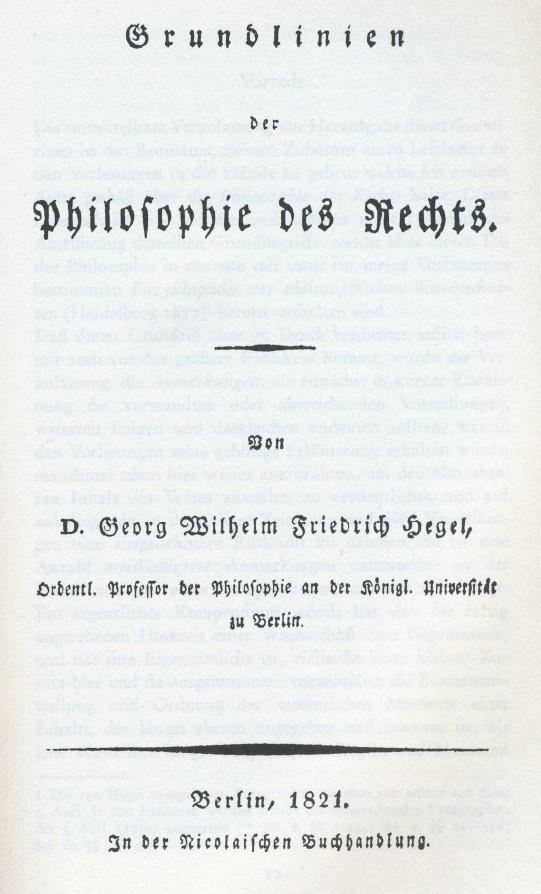
Part A · ReadersTwo centuries of readers
Schools and readers in the order of their traditions, each with the passages they lean on and who disputes them.
R1Right and Left Hegelians, Feuerbach, Marx, Kierkegaard, the late Schelling, Trendelenburg
What they read: the Preface (¶9, ¶16), Sense-certainty (¶90–110), work in Lordship and Bondage (¶195–196), the first pages of the Logic (GW 21:68–70), and what Hegel's system means for Christian doctrine.
The school splits: right, center, left
The first quarrel over Hegel's legacy was about religion. Engels, looking back in 1886, dated it from D. F. Strauss's Leben Jesu (1835) and explained it by system and method (U2).I152 The labels are Strauss's own. In Heft 3 of his Streitschriften (Tübingen, 1837), section "Hegel'sche Schule", he asked whether the gospel history, as history, follows from the idea of the unity of divine and human nature: wholly, in part, or not at all (p. 95).I153
Wären diese drei Antworten und Richtungen wirklich jede von einem Zweige der Hegel'schen Schule repräsentirt, so könnte man nach der herkömmlichen Vergleichung die erste Richtung, als die dem alten Systeme am nächsten stehende, die rechte, die dritte die linke Seite, die zweite aber das Centrum nennen.
If these three answers and directions were each really represented by a branch of the Hegelian school, one could, after the customary comparison, call the first direction, as the one nearest the old system, the right, the third the left side, and the second the center. rendering for this page
Strauss, Streitschriften, Heft 3, p. 95 (OCR of the BSB scan; check against the page image)I153
Note the conditional: Strauss offers the division as a hypothesis. Rossi (Britannica, "Hegelianism") names Göschel for the right and Rosenkranz for the center; Breckman (2019) notes that Strauss placed only himself on the left.I154,155 The "Young Hegelians" wrote in Ruge and Echtermeyer's Hallische Jahrbücher, which the Prussian censor suspended in 1841 (Gooch, SEP "Feuerbach", §§1, 3).I156
Feuerbach
Ludwig Feuerbach (1804–1872)H156 defended Hegel against his critics until 1838. Gooch's SEP entry dates the first public break to "Zur Kritik der Hegelschen Philosophie" (Hallische Jahrbücher, 1839); Rossi dates an attack to June 1838, so the two may mean different texts.I154,156 Feuerbach held that Hegel's starting point, pure being, is an abstraction, and rejected his treatment of sense-certainty; the Vorläufige Thesen (1842) charge that Hegel posits the human essence in absolute spirit, continuing theology's alienation in the last great attempt to restore Christianity through philosophy (SEP §5).I156 The Hegel texts in question are Sense-certainty (¶90–110) and the Logic's beginning (GW 21:68–70, 1832).T Marx turned the charge around in the Theses on Feuerbach (1845). In Leopold's account (SEP "Marx", §2.2), earlier materialism ignored the active role of the human subject, while idealism, at least as Hegel developed it, understood that activity but confined it to thought.I157
Marx
Karl Marx (1818–1883) wrote his "Kritik der Hegelschen Dialektik und Philosophie überhaupt" in the Paris manuscripts of 1844 (MEW Ergänzungsband 1, an editorial reconstruction first printed in 1932). One must begin, he says, with the Phenomenology, the "Geburtsstätte" (birthplace) and secret of Hegel's philosophy (p. 571). Its greatness is to grasp the self-production of man as a process and labor as man's essence; its limit is that the only labor Hegel knows is abstract mental labor (p. 574).I104 The Phenomenology's own account of work is the bondsman's (¶195–196).T In 1873 Marx recalled that he had openly avowed himself Hegel's pupil, and said the dialectic stands on its head in Hegel and must be turned over to find "den rationellen Kern in der mystischen Hülle".I158,159 Both texts, with Engels's account of the split, are quoted in U2. Henrich's essay "Karl Marx als Schüler Hegels" is in Hegel im Kontext (p. 188 of the 2010 edition).I138
Kierkegaard
Søren Kierkegaard (1813–1855), as Johannes Climacus in the Concluding Unscientific Postscript (1846), holds that a system of existence is possible for God but not for an existing person (CUP I, 118–125; SKS 7, 114–120). The SEP entry adds that he rejects the disengaged "objective" standpoint and answers the Preface's warning against edification with Either/Or II: only the truth that edifies is truth for you (§4).I160 Hegel's warning:
Die Philosophie aber muss sich hüten, erbaulich seyn zu wollen.
But philosophy must beware of wanting to be edifying. rendering for this page
¶9 · 1807 p. XI · GW 9:14
Readers disagreeHow far is Kierkegaard's polemic aimed at Hegel himself, and how far apart are the two?
Stewart (2003)Kierkegaard's Relations to Hegel Reconsidered: many of the targets were Danish Hegelians such as Martensen, and Hegelian method returns in The Sickness unto Death. Evans's SEP entry calls the case convincing and, in its introduction, names Danish Hegelians rather than Hegel as the main target (§4).I160
Stewart's criticsUnnamed in the SEP: they dispute whether his analysis closes the gap between Kierkegaard and Hegel too far, chiefly on the relation of philosophy and religion (§4).I160
The late Schelling
F. W. J. Schelling (1775–1854) criticized Hegel in the Munich lectures Zur Geschichte der neueren Philosophie (probably 1833–34; Sämmtliche Werke I/10, 1861) and in Berlin from 1841, where his hearers included Kierkegaard, Engels, Bakunin, Ranke, Burckhardt and Alexander von Humboldt.I37,129 In Bowie's account (SEP §5), Hegel's is a "negative" philosophy: it reconstructs the logic of what exists once there is a world, but cannot say why there is a world at all. Schelling poses a dilemma: concept first, with being as its consequence, or being first, without the concept (SW II/3, 164). Rush (2014, pp. 216–237) puts the charge as Hegel's claim that conceptual determination exhausts the world.I37,161 The Preface's night "worin … alle Kühe schwarz sind" (¶16) names no one; Bowie rejects the standard reading of it as a fair account of Schelling's argument (SEP §3).TI37
Trendelenburg
Friedrich Adolf Trendelenburg (1802–1872)H162 charged in his Logische Untersuchungen (1840; 3rd ed. 1870) that the Logic's first transitions presuppose motion, Bewegung, and so smuggle empirical content into pure logic; motion, for him, belongs to thinking and being alike (Kanterian's review of Beiser 2013).I163 In ch. III, "Die dialektische Methode", becoming cannot arise from two resting representations: pure being, equal to itself, is rest (3rd ed., pp. 36–38, as summarized by Bonnell 2016).I128,132 The passage stands on p. 38 of the 1862 and 1870 editions; the 1840 text was not checked.I128,131 He returned to the question in Die logische Frage in Hegel's System (1843).I164 Hegel's own word for the truth of being and nothing is movement:
Ihre Wahrheit ist also diese Bewegung des unmittelbaren Verschwindens des einen in dem andern
Their truth is therefore this movement of the immediate vanishing of the one into the other rendering for this page
GW 21:69 · 1832 (same sentence, without the emphasis, in 1812, 1812 p. 23)
Readers disagreeDoes Hegel's beginning produce movement, or borrow it (GW 21:69)?
Trendelenburg (1840; 3rd ed. 1870)Motion is presupposed, not derived; two resting terms cannot yield becoming (pp. 36–38). Bonnell (pp. 26–27) reports Beiser's reconstruction of the premise: self-identity implies rest.I132
Houlgate (2006)The vanishing of being and nothing into each other is itself a process sufficient for movement (as reported by Bonnell, pp. 37–38, 40).I62,132
Sources for R1: 37, 62, 104, 128–129, 131–132, 138, 152–164.
R2British and American idealism: Stirling, Green, Bradley, McTaggart
What they read: above all the Logic, its opening section "Quality" (from GW 21:68 in the 1832 text) and the Encyclopaedia Logic; the Phenomenology was largely ignored (Redding, SEP "Hegel", §2, introduction).I15
Stirling's "secret"
J. H. Stirling's The Secret of Hegel (London, 1865, 2 vols; new ed. Edinburgh, 1898) brought the Logic to British readers. Its Part II translates the whole first section of the Logic, "Quality" (Being, Nothing, Becoming and what follows), with commentary.I165 Stirling states the secret by analogy: as Aristotle made explicit the abstract universal implicit in Socrates, so Hegel "made explicit the concrete Universal that was implicit in Kant" (1898, Preliminary Notice, pp. xxii–xxiii).I165 The second volume of 1865 puts it as "Intellectual Function is the secret", the Logic being the principle of the whole.I166
Green and Bradley
T. H. Green (1836–1882)H167 became the leading Hegelian at Oxford and carried Hegelian ideas into ethics; John and Edward Caird applied them to religion (Rossi, Britannica, "Hegelianism").I154 F. H. Bradley (1846–1924) refused the label in the Preface to The Principles of Logic (1883):
I never could have called myself an Hegelian, partly because I can not say that I have mastered his system
Bradley, The Principles of Logic (1883), PrefaceI168
The other reason he gives is that he could not accept what seemed the system's main principle.I168 Rossi reads Appearance and Reality (1893) as moving away from Hegel's panlogism toward a dualism of appearance and reality.I154
McTaggart
J. M. E. McTaggart (1866–1925) wrote Studies in the Hegelian Dialectic (1896; 2nd ed. 1922), Studies in Hegelian Cosmology (1901) and A Commentary on Hegel's Logic (1910). The Studies take the dialectic's first aim to be logical connection between the categories, guided by the complete idea already implicit in consciousness (§§1–4, pp. 1–4 of the 2nd ed.).I169
the dialectic must be looked on as a process, not of construction, but of reconstruction.
McTaggart, Studies in the Hegelian Dialectic, §3 (2nd ed. 1922, p. 3)I169
Citing Enc. §240, he holds that the form of advance changes from Being to Essence to Notion, so that passing into the contrary counts for less as the Logic goes on (§2, p. 2).I169 The Commentary adopts the Greater Logic as its text throughout, noting where the Encyclopaedia differs, although McTaggart judges the Encyclopaedia the better authority for Essence and Notion; it finds the method valid though particular transitions fail, and reads the whole Logic as one triad (Introd. §§2–5, pp. 1–5).I84 Whether the method is triadic at all is the question of U5. McDaniel's SEP entry reports that McTaggart read Hegel's Absolute as a community of finite spirits bound by love, close to his own view, and that he later gave up the dialectical method (§§1, 4, 5).I170
St. Louis
In the United States, Henry Brokmeyer and William T. Harris (1835–1909)H171 founded the St. Louis Philosophical Society, which published The Journal of Speculative Philosophy. Rossi says the group sought a dialectical basis for American democracy.I154
Russell and Moore's revolt
Russell and Moore had both been taught by McTaggart; Moore valued his insistence on asking what a claim means (SEP "McTaggart", §1).I170 Redding's SEP entry describes how the two made Hegel a main target of the new analytic philosophy; Russell held that the logic of Frege and Peano had overturned the Aristotelian logic he thought Hegel relied on (§§1, 3.1.2).I15 In Our Knowledge of the External World (1914), Lecture II, Russell says that Hegel and his followers widened logic in a way he thinks fallacious, while still assuming the ordinary logic they criticize. His note 12 cites Macran's 1912 translation of the first section of the Subjective Logic and charges that the argument there depends on "confusing the 'is' of predication" with the "is" of identity.I150 That section, on concept, judgment and syllogism, begins at GW 12:31 (1816); the judgment chapter at GW 12:53.T
Readers disagreeDid the analytic revolt read Hegel's logic, or a shadow of it?
Russell (1914)Hegel's system assumes the ordinary logic it criticizes, and confuses predication with identity (Lecture II, n. 12).I150
Redding (2007)Analytic Philosophy and the Return of Hegelian Thought: Russell's Hegel was a distorted "shadow"; Hegel should not be forced into propositional and quantificational logic. DeVries's review reports his contrast of a Frege–Wittgenstein strand of analytic philosophy with the Russell–Moore strand. On the later return to Hegel, see R5.I92
Sources for R2: 15, 84, 92, 150, 154, 165–171.
R3French readers: Wahl, Kojève, Hyppolite, Sartre, Lacan, Deleuze, Derrida, Malabou
What they read: first the Phenomenology's chapter IV: desire (¶167), lordship and bondage (¶178–196), the unhappy consciousness (¶206–230); later the Logic's difference and contradiction (GW 11:265–290) and the Encyclopaedia's psychology and anthropology.
Wahl: the unhappy consciousness
Jean Wahl (1888–1974) put the unhappy consciousness at the center in Le malheur de la conscience dans la philosophie de Hegel (1929). Bernasconi, reviewing Baugh's French Hegel (2003), notes that Baugh builds his history around this book; that the formula of the human being who is what he is not, often credited to Sartre or Kojève, is Wahl's; and that "transcendental empiricism" was Wahl's phrase before it was Deleuze's. He judges the case for Wahl's influence stronger than the case for his reading of Hegel.I107
das unglückliche Bewusstseyn ist das Bewusstseyn seiner als des gedoppelten nur widersprechenden Wesens.
the unhappy consciousness is the consciousness of itself as the doubled, merely contradictory being. rendering for this page
¶206 · 1807 pp. 140–141 · GW 9:121
Kojève: desire, labor, the end of history
Alexandre Kojève (1902–1968) lectured on the Phenomenology at the École pratique des hautes études from 1933 to 1939, to hearers who included Aron, Bataille, Lacan, Merleau-Ponty and Queneau; the lectures became Introduction à la lecture de Hegel (1947). In Frost's summary, history is a dialectic driven by the desire for Anerkennung: the master's recognition does not satisfy, the slave moves history on by labor, Hegel's dialectic of nature is dropped, and history ends with the Revolution and Napoleon.I95 Redding credits him with first making the struggle of chapter IV prominent, and Iser traces his influence on Sartre and Lacan (SEP "Hegel", §3.1.1; SEP "Recognition", §1.1).I15,105 Hegel's figures are Herr and Knecht; the word "Sklave" does not occur in the 1807 text.T Accounts of Kojève's late note on Japan disagree about what it says on the end of history; see U3.I123,124,172
Hyppolite
Jean Hyppolite wrote Genèse et structure de la Phénoménologie de l'esprit de Hegel (1946).I173 In Logique et existence (1953), as Deleuze's 1954 review summarizes it, philosophy must be an ontology of sense and leave anthropology behind; absolute knowledge is present from the start of the Phenomenology; being is sense, with no beyond, and logical discourse is where Being says itself. Deleuze asked whether contradiction is not less than difference, perhaps only its phenomenal side (Revue philosophique 144, pp. 457–60).I89 Hyppolite taught Derrida and was to direct his thesis (SEP "Derrida", §1).I174
Readers disagreeIs the Phenomenology an anthropology, a story of human desire and labor (¶178–196)? (The pairing is ours.)
Kojève (1933–39)Yes: history is human desire for recognition worked out in labor; Hegel's philosophy of nature drops away.I95
Hyppolite (1953)No: philosophy must become an ontology of sense and leave anthropology behind; absolute knowledge is there from the start (as reported by Deleuze 1954).I89
Sartre and Lacan
Jean-Paul Sartre (1905–1980), in L'Être et le néant (1943), makes concrete relations with others conflict, not Mitsein. Renaudie's SEP entry reads this as the master–slave stage restated without the possibility of overcoming it (Eng. 1956, p. 429).I175 Hegel's text sets out mutual recognition as the pure concept (¶184–185) and lordship as "ein einseitiges und ungleiches Anerkennen" (¶191).T R. R. Williams (1992) gives chapters to Sartre's reading and criticism of Hegel.I176 Jacques Lacan (1901–1981)H177 heard Kojève; the SEP entry on Lacan reads "man's desire is the desire of the Other" as a Hegelian-Kojèvian slogan, likens the symbolic order to Hegel's objective spirit and the circling of desire to Hegel's bad infinity (§§1, 2.1.2, 2.4.2–3); see U4.I177 In Hegel, self-consciousness first appears as "Begierde überhaupt", desire in general (¶167).T
Deleuze
Gilles Deleuze (1925–1995) set out to hasten a departure from Hegel, the emblem for him of the privilege of identity. Against a dialectical model of contradiction, Différence et répétition (1968) offers a problematic, genetic model of "difference in itself"; Nietzsche et la philosophie (1962) already turns to affirmative, non-dialectical forces (SEP "Deleuze", §§2, 3.1).I178 Hegel's own chapters on difference and contradiction are in the 1813 Doctrine of Essence (GW 11:265–290); which pages Deleuze cites is not recorded here.T Stern's Hegelian Metaphysics (2009) ends by examining this "continental" critique.I179
Derrida and Malabou
Jacques Derrida (1930–2004) wrote "Le puits et la pyramide" in Hyppolite's seminar (1968; in Marges de la philosophie, 1972). Mistral (2024, pp. 891–905) shows it reading the Encyclopaedia's paragraphs on sign and writing (Enc. 1830 §§457–459) to find the privilege of speech over writing at work in Hegel, with writing and the plastic arts as residues that resist sublation (aufheben).I180 Glas (1974) runs Hegel in a left-hand column beside Genet on the right (SEP §1).I174 Catherine Malabou's The Future of Hegel (English 2005, tr. Lisabeth During, preface by Derrida) takes "plasticity" as the name for Hegel's thinking about time, with a future open to change; it sets itself against Heidegger's account of Hegel's concept of time in Being and Time (R4) and works through the Encyclopaedia's Anthropology and habit (publisher's description).I181
Sources for R3: 15, 89, 95, 105, 107, 123–124, 172–181.
R4German readers: Dilthey, Lukács, Heidegger, Marcuse, Adorno, Henrich, Theunissen, Fulda
What they read: the youthful manuscripts (Dilthey, Lukács); the Phenomenology's Introduction (¶73–89) and Preface (¶20); the Logic's claim to replace metaphysics (GW 21:48), its doctrine of reflection (GW 11:249–257) and its relation to the Phenomenology (GW 21:33).
Dilthey and Lukács: the young Hegel
Wilhelm Dilthey (1833–1911) re-examined Hegel's youthful manuscripts in 1905; in Rossi's account for Britannica, the study brought out their irrationalist and vitalist sides, and his pupil Herman Nohl published them as Hegels theologische Jugendschriften (1907).I154 Dilthey's Hegel is the Hegel before the two books.
Georg Lukács (1885–1971) read Hegel twice. In Geschichte und Klassenbewußtsein (1923) Hegel comes closest of the bourgeois thinkers to overcoming reification, treating subject and object as moments of a producing process; but his World Spirit is a mythology, and the proletariat becomes the subject-object of history (SEP "Lukács", §3.1). Der junge Hegel (Zürich and Vienna, 1948; written partly in Moscow in the 1930s) argues that Hegel's reading of Steuart and Smith shaped his dialectic and let him see modern society as a moving totality of contradictions, an objectivism he later subordinated to logicism (§§1, 4.2).I182 In 1967 Lukács said he had confused objectification with alienation, and that Hegel was right to treat objectification as a necessary stage; Martin Jay objects that the subject-object idea implies a Fichtean self-constitution (§4.1).I182 On Lukács and Marx's 1844 reading of labor, see U2.
Heidegger and Marcuse
Martin Heidegger (1889–1976) lectured on the Phenomenology in winter 1930/31 (GA 32) and wrote "Hegels Begriff der Erfahrung" (Holzwege, 1950; GA 5) from a seminar of 1942/43. The essay reads the Introduction (¶73–89): Hegel carries Descartes's self-certain subject through to absolute knowing; experience is the way absolute consciousness comes to presence; truth as unconcealment remains unthought.I88 In GA 32 Heidegger calls the Phenomenology the fundamental ontology of absolute ontology (p. 204) and Hegel's thought Onto-theo-ego-logie; he sets Hegel's infinity against his own finitude, makes "Force and Understanding" the hinge from finite consciousness to the infinity of spirit, and seeks a conversation, Gespräch, with Hegel (p. 44). Sell (1998, pp. 13–17) reports this and asks whether it fits Hegel's own aims (p. 16).I93 Hegel defines Erfahrung in the Introduction:
Diese dialektische Bewegung, welche das Bewusstseyn an ihm selbst, sowohl an seinem Wissen, als an seinem Gegenstande ausübt, in sofern ihm der neue wahre Gegenstand daraus entspringt, ist eigentlich dasjenige, was Erfahrung genannt wird.
This dialectical movement, which consciousness exercises on itself, on its knowing as well as on its object, insofar as the new true object springs from it, is properly what is called experience. rendering for this page
¶86 · 1807 p. 18 · GW 9:60
Herbert Marcuse (1898–1979) wrote Hegels Ontologie und die Theorie der Geschichtlichkeit (1932) as Heidegger's assistant; Heidegger never approved it. Reason and Revolution (1941) argues that Hegel's revolutionary concepts shaped Marx, defends Hegel against the charge of serving the Prussian state, and tries to rescue negative, dialectical thinking (SEP "Marcuse", §§1, 3.3).I183
Adorno: "Das Ganze ist das Unwahre"
Theodor W. Adorno (1903–1969; Drei Studien zu Hegel, 1963; Negative Dialektik, 1966) keeps Hegel's speculative identity of thought and being as a goal but denies that it has been reached positively: identity has come about only negatively, by thought forcing unity on objects. He refuses the affirmative close of Hegel's dialectic and uses determinate Negation to give indirect access to the nonidentical (SEP "Adorno", §§3, 5).I87 In Minima Moralia (1951; Eng. p. 50) he turns the Preface around (§7.1).I87
Das Wahre ist das Ganze. Das Ganze aber ist nur das durch seine Entwicklung sich vollendende Wesen.
The true is the whole. But the whole is only the essence that completes itself through its development. rendering for this page
¶20 · 1807 p. XXIII · GW 9:19
Henrich, Theunissen, Fulda: the Logic as critique
Dieter Henrich's Hegel im Kontext (1971; new ed. 2010) gathers essays on Hölderlin, on the historical premises of the system, on "Anfang und Methode der Logik" (p. 73 of the 2010 ed.), "Hegels Logik der Reflexion" (p. 95), contingency (p. 158) and Marx (p. 188). Its preface says the Logic essays argue inside the work, testing readings rather than reporting or judging from outside.I138 Hegel's account of reflection is in the first chapter of the 1813 Doctrine of Essence (GW 11:249–257).T Redding's SEP entry (§1) credits the work of Henrich and Horstmann, together with Hartmann's non-metaphysical reading, with a role in the revival of academic interest in Hegel; in §2.4 it cites Horstmann (2006) among the critics of the post-Kantian view (R5).I15
Michael Theunissen's Sein und Schein (1978) reads the objective logic as a critical presentation of traditional metaphysics that dissolves its Schein, and the whole Logic as a theory of communicative freedom, worked out in the subjective logic but partly undercut by Hegel's restoration of special metaphysics and a "theology of domination" (as summarized by Fulda and Horstmann, 1980, pp. 12–13).I127 Hegel's own statement of the relation:
Die objective Logik tritt damit vielmehr an die Stelle der vormaligen Metaphysik, als welche das wissenschaftliche Gebäude über die Welt war, das nur durch Gedanken aufgeführt seyn sollte.
The objective logic thus takes the place, rather, of the former metaphysics, which was the scientific edifice about the world that was to be raised by thoughts alone. rendering for this page
GW 21:48 · 1832 (1812: "tritt somit überhaupt an die Stelle", 1812 p. 4)
Readers disagreeThe Logic is a critical presentation of metaphysics: all three accept that. What does the formula amount to (GW 21:48)?
Theunissen (1978; "Antwort", 1980, pp. 47–106)Critique of metaphysics carried by a theory of communicative freedom, compromised by a theology of domination (pp. 12–13).I127
Fulda and Horstmann (1980)"Fragen zu Michael Theunissens Logik-Deutung" (pp. 10–46) and their replies (pp. 107ff.) dispute what the unity of critique and presentation is (Vorbemerkung, p. 7).I127
Hans Friedrich Fulda wrote the earlier Das Problem einer Einleitung in Hegels Wissenschaft der Logik (1965).I61 Stewart (2020, n. 2) cites his essay "Zur Logik der Phänomenologie von 1807" (1973, pp. 391–422) in the debate over the unity of the Phenomenology.I32 The book's problem is Hegel's: the Phenomenology is "nichts anderes als die Deduction" of the concept of pure science (GW 21:33), and the Logic has the science of appearing spirit "zu ihrer Voraussetzung" (GW 21:54–55, 1832; 1812 p. 6 makes the same presupposition in other words).T
Sources for R4: 15, 32, 61, 87–88, 93, 127, 138, 154, 182–183.
R5Anglophone readers: Taylor, Hartmann, Pippin, Pinkard, Brandom, McDowell, Houlgate, Beiser, Stern, Harris, Burbidge
What they read: the Logic's account of its own content (GW 21:34) and beginning (GW 21:68–70); the Concept's praise of Kant (GW 12:17–18); the Phenomenology's chapters I–IV (¶90–196) and forgiveness (¶666–671).
Three camps
Redding's SEP entry sorts recent readers into a traditional metaphysical reading (Taylor, Beiser), a post-Kantian reading, once called non-metaphysical (Hartmann, Pippin, Pinkard, Brandom, McDowell), and a revised metaphysical reading (Houlgate, Stern, Kreines). The name "post-Kantian" replaced the older one because it wrongly implied that Hegel had no metaphysics (§§1, 2.2–2.4).I15 One text at issue:
Man kann sich deßwegen ausdrücken, daß dieser Inhalt die Darstellung Gottes ist, wie er in seinem ewigen Wesen vor der Erschaffung der Natur und eines endlichen Geistes ist.
One can therefore put it this way: this content is the presentation of God as he is in his eternal essence before the creation of nature and of a finite spirit. rendering for this page
GW 21:34 · 1832, Introduction
Readers disagreeIs the Logic metaphysics, and in what sense (GW 21:34, GW 21:48)? (Camps as classified by Redding.)
Taylor (1975); Beiser (2005)Yes, in the traditional sense: God's mind is actual only in finite minds, whose consciousness of God contributes to God's self-consciousness (SEP §2.2).I15
Pippin (1989); Pinkard (1994)Hegel completes Kant's critique of metaphysics; for Pippin the Logic is a science of pure thinking whose forms are forms of being, metaphysics in a new sense (SEP §§2.3–2.4).I15
Houlgate (2006); Stern (2009)A revised metaphysics: Hegel accepts Kant's critique of rationalist metaphysics, yet the Logic is ontology (Houlgate); concepts are objective universals in the world (Stern) (SEP §§2.4, 3.2.1).I15
Taylor, Hartmann, Pippin, Pinkard
Charles Taylor's (b. 1931) Hegel (1975) gives the Phenomenology pp. 125–222 and the Logic pp. 223–362.I83 In Hoy's critical notice, Taylor holds that the inner, Geist, exists only in external reality (Taylor p. 291), and that reality is not foreign to thought (p. 301).I184 Klaus Hartmann's "Hegel: A Non-Metaphysical View" (in MacIntyre, ed., Hegel, 1972; repr. 1988, pp. 267–287) gave the opposing camp its first name (SEP §1).I15,185,186 Robert Pippin (b. 1948), in Hegel's Idealism (1989), reads Hegel as deindividualizing and historicizing Kant's freedom as self-determination (SEP §2.3).I15 His Hegel's Realm of Shadows (2019) takes its title from Hegel's "Reich der Schatten" (GW 21:42) and its subtitle claims "Logic as Metaphysics".TI85 Hegel himself counts Kant's unity of apperception among the deepest insights of the Critique of Reason (GW 12:17–18, 1816).T For the reading that the Phenomenology tracks the development of a type of social existence, Redding cites Terry Pinkard (b. 1947) as an example (Hegel's Phenomenology: The Sociality of Reason, 1994; SEP §3.1.1).I15
Brandom and McDowell
Robert Brandom (b. 1950) reads determinate negation as material incompatibility (nothing is both square and triangular), of which formal negation is a shadow; Hegel's holism is weak, and his objective idealism a claim of reciprocal sense-dependence (Tales of the Mighty Dead, 2002, ch. 6, pp. 256–285, citing ¶111, ¶134, ¶161–168, ¶789).I91 A Spirit of Trust (2019) adds that normative statuses are instituted by social practices, and that recollective, forgiving recognition founds communities of trust in a postmodern age; Observing Reason and Religion are largely left out (Houlgate's review, citing Brandom pp. 50–61, 634, 666–670, 675, 720).I86 Redding (2007) finds the material-incompatibility account of determinate negation inadequate.I92
Die Wunden des Geistes heilen, ohne dass Narben bleiben; die That ist nicht das unvergängliche, sondern wird von dem Geiste in sich zurückgenommen
The wounds of spirit heal, and no scars remain; the deed is not the imperishable, but is taken back by spirit into itself rendering for this page
¶669 · 1807 p. 620 · GW 9:360
Readers disagreeIs the forgiveness of ¶666–671 a retrospective, recollective trust?
Brandom (2019)Yes: recollective, forgiving recognition, with a retrospective necessity (Brandom p. 631), founds a community of trust.I86
Houlgate (2020)The theses are Brandom's (via Sellars and Rorty), not Hegel's; the book moves forward immanently (¶26, ¶78), not retrospectively; forgiveness releases the other from judgment (¶666, ¶670); trust is modern, not postmodern.I86
John McDowell (b. 1942), "The Apperceptive I and the Empirical Self" (Hegel Bulletin 24, 2003, pp. 1–16), starts from Hegel's project of closing the gulf between subject and object, built on Kant's apperception, and reads lord and bondsman as aspects of a single self-consciousness (¶177); Pippin (2011, p. 44) rejects this, and the dispute is set out in U4.I97,99
Houlgate, Beiser, Stern, Harris, Burbidge
Stephen Houlgate's The Opening of Hegel's Logic (2006) holds that the Logic begins with thought itself as pure being (SEP §2.4); against Trendelenburg he finds movement in the vanishing of being and nothing (R1); against Brandom, he takes the Logic as an a priori derivation of the categories.I15,86,132 Stern (2023, pp. 319–326) discusses his later Hegel on Being.I130 Frederick Beiser (b. 1949), Hegel (2005), sets aside Hartmann's categorial reading, Pippin's neo-Kantianism and Pinkard's social epistemology; absolute idealism is an organicist metaphysics with an immanent God, and lordship and bondage answer Fichte and nihilism, "a moral rather than a metaphysical refutation" (p. 191). Donougho's review objects that Beiser psychologizes the struggle, neglects labor, fear and service, ignores H. S. Harris and leaves out most of the Logic.I187 Robert Stern's Hegelian Metaphysics (2009) defends the conceptual realism noted above (SEP §3.2.1) and ends with the "continental" critique (R3).I15,179 Two commentaries complete the list: H. S. Harris's Hegel's Ladder (2 vols, 1997) on the Phenomenology and John Burbidge's On Hegel's Logic: Fragments of a Commentary (1981).I64,188
Sources for R5: 15, 64, 83, 85–86, 91–92, 97, 99, 130, 132, 179, 184–188.
R6Feminist readings: Irigaray, Butler, Mills
What they read: the ethical world and its tragedy (¶446–476): human and divine law, man and woman, the brother–sister bond (¶457–459), Antigone's line (¶470), womankind as "the eternal irony of the community" (¶475); for Butler in 1987, also desire and recognition (¶167–196).
Hegel's text
In the ethical world of Greek spirit, Hegel divides the human law of the community from the divine law of the family. The relation of brother and sister is the purest, and the woman, as sister or wife, guards the divine law (¶457–459).T When ethical consciousness acts, it must own its guilt, and Hegel gives Antigone's words in his own German; he names Antigone in the book twice, at ¶437 and here.T
es muss seine Schuld anerkennen; weil wir leiden, anerkennen wir, dass wir gefehlt
it must acknowledge its guilt; because we suffer, we acknowledge that we have erred rendering for this page
¶470 · 1807 p. 412 · GW 9:256
The community lives by disrupting the family's happiness, and so produces, in what it suppresses, its inner enemy:T
an der Weiblichkeit überhaupt seinen innern Feind. Diese, — die ewige Ironie des Gemeinwesens — verändert durch die Intrigue den allgemeinen Zweck der Regierung in einen Privatzweck
in womankind in general its inner enemy. This, the eternal irony of the community, changes by intrigue the universal end of the government into a private end rendering for this page
¶475 · 1807 pp. 418–419 · GW 9:259
Mills: what Hegel does to the play
Patricia Jagentowicz Mills, in "Hegel's Antigone" (The Owl of Minerva 17:2, 1986, pp. 131–152), argues that Hegel flattens Sophocles' play into a clash of equal powers and passes over Ismene, the bond between sisters, and Antigone's deliberate choice and suicide. He also alters her words so that she seems to admit guilt, as his model of tragic guilt requires.I112 On the textual point the comparison is plain: Hegel's sentence renders only line 926 and drops the condition of line 925.TI111
ἀλλʼ εἰ μὲν οὖν τάδʼ ἐστὶν ἐν θεοῖς καλά, / παθόντες ἂν ξυγγνοῖμεν ἡμαρτηκότες·
But if these things are noble among the gods, / then, having suffered, we would come to know that we had erred. rendering for this page
Sophocles, Antigone 925–926 (Storr's Greek text, Perseus)I111
Mills also edited Feminist Interpretations of G. W. F. Hegel (1996), with essays by Benhabib, Irigaray, Lonzi, O'Brien, Pateman, Ravven, Schor and others. The publisher's account says the contributors disagree whether Hegel's system resolves the question of identity and difference; some read his explicit remarks on women, others the margins of the text, and all go beyond Beauvoir's reading.I115
Irigaray
Luce Irigaray is among the contributors to Mills's volume.I115 Hutchings (2010) groups her with Hegel and Butler: all three, she argues, see Antigone's ethical weight as exceeding the binary of divine and human law (as summarized in Gauthier's review).I114
Butler
Judith Butler (b. 1956) began with Subjects of Desire (1987), a history of desire from the Phenomenology's master and servant (¶178–196) through Kojève and Hyppolite to Sartre, Lacan, Deleuze, Derrida and Foucault, whose genealogy dissolves the desiring subject (pp. 234ff., per Cremaschi's review); see R3.I106 Antigone's Claim (2000) makes Antigone a figure of defiance whose claim puts normative kinship in question, read against Hegel, Lacan and Irigaray.I113
Beyond Antigone?
A later collection, Hegel's Philosophy and Feminist Thought: Beyond Antigone? (ed. Hutchings and Pulkkinen, 2010), widens the frame. In Gauthier's review, Chanter argues that Hegel's reading of tragedy reasserts a unity that tragic conflict disturbs, and links his sexism with the play's taking slavery as natural.I114
Readers disagreeIs the ethical world (¶446–476) a reading of Sophocles' Antigone at all?
Mills (1986)Yes, and a distorting one: Hegel reshapes the play and Antigone's words (¶470) to fit his scheme of two equal laws and tragic guilt.I112
de Boer (2010)Doubtful: the chapter's remarks on woman more likely concern the decline of Greek culture, with Aristophanes and Plato in view (per Gauthier's review).I114
Readers disagree about what the text saysDoes Hegel's own account fold Antigone's conflict back into a unity, or does her ethical weight exceed the binary of the two laws (¶446–476)? The pairing of these two views is ours.
Chanter (2010)Hegel's reading of tragedy reasserts the unity that tragic conflict disturbs (per Gauthier's review).I114
Hutchings (2010)Hegel, like Irigaray and Butler, sees Antigone's ethical significance as exceeding the binary of divine and human law (per Gauthier's review).I114
Sources for R6: 106, 111–115.
R7Postcolonial and race: Fanon, Buck-Morss, Tibebu
What they read: Lordship and Bondage (¶178–196): the risk of life (¶187), the lord's enjoyment and one-sided recognition (¶190–191), the bondsman's work (¶195–196); and, for Tibebu, Hegel's account of world history.
What the text names
Hegel's chapter names no place, people or event. Its figures are Herr and Knecht, lord and bondsman; the words "Sklave" and "Sklaverei" occur nowhere in the 1807 text.T The readers below set these figures beside real slavery and colonial rule.
Fanon
Frantz Fanon (1925–1961) gives the last full chapter of Peau noire, masques blancs (Paris: Seuil, 1952), ch. 7, to a critical reading of dialectics through Adler and Hegel. In Drabinski's SEP account, recognition is the stake: Fanon refuses a recognition measured by the colonizer's standard, and he is drawn to the risk of life at the center of Hegel's dialectic. Dialectical negation, on this reading, becomes confrontation aimed at destroying existing relations.I103
Das Individuum, welches das Leben nicht gewagt hat, kann wohl als Person anerkannt werden; aber es hat die Wahrheit dieses Anerkanntseyns als eines selbstständigen Selbstbewusstseyns nicht erreicht.
The individual who has not risked life may well be recognized as a person; but it has not attained the truth of this being-recognized as an independent self-consciousness. rendering for this page
¶187 · 1807 p. 119 · GW 9:111
Macey (1999, p. 12), citing Peau noire (Points ed., 1975), p. 179 n. 2 and p. 181, draws out Fanon's objection: Hegel's dialectic ignores the cane fields, and the plantation owner wants work from the slave, not recognition.I102 In Hegel's text the lord does take from the bondsman's work his enjoyment, Genuss (¶190), and the recognition that results is "ein einseitiges und ungleiches Anerkennen" (¶191).T The pairing of Fanon with Buck-Morss is discussed in U1.
Buck-Morss: Hegel and Haiti
Susan Buck-Morss, "Hegel and Haiti" (Critical Inquiry 26:4, 2000, pp. 821–865; expanded as Hegel, Haiti, and Universal History, 2009), argues that the lordship–bondage dialectic, conceived in Jena in 1803–05 and written up in 1805–06, was shaped by the Haitian Revolution. Hegel could follow it in Archenholz's journal Minerva, which ran a year-long series on Saint-Domingue in 1804–05 (pp. 838–848).I68 She grants that the Phenomenology does not mention Haiti (p. 844 n. 74), calls part of her case "only a hypothesis" (p. 847 n. 79), and credits Pierre-Franklin Tavarès with raising Hegel and Haiti before her, from the later Hegel (p. 843 n. 71).I68 She also charges that Kojèvian and Marxist readings turned real slavery into a metaphor (pp. 849–850; see R3).I68
Readers disagreeDid the Haitian Revolution shape Lordship and Bondage (¶178–196)?
Buck-Morss (2000, 2009)Yes, as a hypothesis: Hegel read the Minerva reports while the dialectic took shape, and scholars have ignored the link (pp. 838–848).I68,70
Stephanson (2010); Kirkland; Sepinwall (2010)Stephanson accepts that Hegel knew of Haiti but denies that the dialectic derives from it; Hegel's only explicit public comment on Haiti dates from 1830 (New Left Review 61).I69 Kirkland grants documented awareness, not endorsement or philosophical derivation (Logos).I70 Sepinwall finds little new evidence, notes that Haitian scholars knew the link, and records criticism of the essay for reviving universal history (The Americas 66:3, pp. 407–408).I101
Readers agreeHegel knew of the Haitian Revolution at some point: Buck-Morss argues it, Stephanson accepts it in general terms (Hegel's only explicit comment dates from 1830), and Kirkland treats the awareness as documented. Whether he knew of it while writing ¶178–196 is part of the dispute, along with derivation.I68,69,70
Tibebu
Teshale Tibebu's Hegel and the Third World: The Making of Eurocentrism in World History (Syracuse UP, 2011; 443 pp.) states its thesis in its subtitle. Its chapters include "The struggle for recognition: the dialectic of lordship and bondage", "Race, gender, and class" and "Africa: the domain of the senses".I189
- "Master–slave dialectic" is Hegel's phrase.The 1807 heading is "Herrschafft und Knechtschafft" (1807 p. 114, GW 9:109), and the figures are Herr and Knecht (¶189). The master–slave wording travels with Kojève's reading (Yar, IEP "Kojève").TI96
- "Buck-Morss shows that the Phenomenology speaks of Haiti."She says it does not (2000, p. 844 n. 74); her claim is about what shaped the chapter.I68
Sources for R7: 68–70, 96, 101–103, 189.
⁂The schools compared
Thirteen schools × six questions · sources: reference works, reviews and the readers' own texts where opened
This table sets the schools of Hegel reading side by side on six questions. Each cell is a short claim with its source. Most claims come from reference works (the Stanford Encyclopedia, Britannica) and reviews, not from the readers' full books; where a reader's own text was opened, the page is given. A dash (—) means not recorded in the sources checked. It does not mean the school has no view. "Contrast ours" marks a pairing made for this page, not by the sources. The last column records disagreements inside a school.
The chapters U1–U5 follow five of these lines further, with the texts on both sides.
Sources for ⁂: 10, 15, 37, 55, 68, 83–84, 86–89, 91–93, 95, 97, 99, 101–107, 115, 127, 152–158, 163, 165, 168–170, 175, 177–178, 180–183, 187, 189–191.
Part B · UsesUses and misuses
Where Hegel’s ideas travelled outside the scholarship, with scholarly and popular claims kept apart.
U1Recognition theory: Honneth, Taylor, Fraser · Anerkennung
Hegel loci: ¶177 · ¶178–196 (GW 9:109–116) · Jena Realphilosophie 1805/06 · Philosophy of Right 1820
What Hegel wrote
Hegel's term is Anerkennung (recognition). In the Phenomenology it becomes the theme at the end of the opening section of chapter IV (¶166–177), where a self-consciousness has another self-consciousness as its object; Hegel says that with this "the concept of spirit" is already present for us (¶177).T
Es ist ein Selbstbewusstseyn für ein Selbstbewusstseyn. … Ich, das Wir, und Wir, das Ich ist.
It is a self-consciousness for a self-consciousness. … I that is We, and We that is I. rendering for this page
¶177 · 1807 pp. 112–113 · GW 9:108
The struggle follows. A self that has not risked its life can be recognized as a person, but has not reached the truth of being recognized as independent (¶187).T
Das Individuum, welches das Leben nicht gewagt hat, kann wohl als Person anerkannt werden; aber es hat die Wahrheit dieses Anerkanntseyns als eines selbstständigen Selbstbewusstseyns nicht erreicht.
The individual who has not risked life can well be recognized as a person; but it has not reached the truth of this being-recognized as an independent self-consciousness. rendering for this page
¶187 · 1807 p. 119 · GW 9:111
The Phenomenology is not Hegel's only text on recognition. According to Iser's SEP entry, the Jena Realphilosophie of 1805/06 takes up Fichte's idea of being "summoned" by another subject (Grundlage des Naturrechts, 1796, §§3–4) and, drawing on Hobbes, recasts the state-of-nature conflict as a struggle for recognition rather than for self-interest; the Philosophy of Right gives the most systematic account of recognition in institutions.I105 Those two texts were not opened for this page.
Scholarly claims
- Axel Honneth, Kampf um Anerkennung (Suhrkamp, 1992; English The Struggle for Recognition, MIT Press, 1995). The first part reconstructs Hegel's argument, and the publisher's blurb names Hegel's Jena writings as the main inspiration.I192 Honneth distinguishes three spheres of recognition: love, rights (respect), and esteem (solidarity) (1995, ch. 5); he discusses Hegel's state-of-nature story at 1995 pp. 44–45.I105
- Charles Taylor, "The Politics of Recognition", in A. Gutmann (ed.), Multiculturalism (Princeton UP, 1992), pp. 25–73. Taylor separates recognition of equal dignity, recognition of difference, and loving care (p. 37).I105
- Nancy Fraser and Axel Honneth, Redistribution or Recognition? A Political-Philosophical Exchange (Verso, 2003): Fraser pp. 7–109; Honneth pp. 110–197; Fraser's rejoinder pp. 198–236; Honneth's pp. 237–267.I105 The research for this page recorded the structure of the exchange, not its arguments, so we do not summarize them.
- Robert R. Williams, Recognition: Fichte and Hegel on the Other (SUNY, 1992), has chapters on the life-and-death struggle, on mastery and servitude, and on Sartre's reading of Hegel.I176 In Hegel's Ethics of Recognition (1997, pp. 59–68) he argues that adequate recognition needs an institutional order of rights.I105
- Robert Pippin reads the social world as cooperatively constructed and develops an account of "social freedom" (2008, ch. 7).I105 In 2011 he argues that the authority of a claim depends on another's recognition (pp. 22–23, 83, as reported by Inwood).I97
- Robert Brandom treats recognition as a normative attitude: taking someone as the subject of normative statuses (2007, p. 136).I105
Readers disagreeIs recognition, in ¶178–196, a struggle that drives history, or a structure of norms?
Kojève (lectures 1933–39)History is a dialectic driven by the desire for recognition; the master's recognition does not satisfy, and the slave moves history on through labor.I95 SEP credits Kojève with first making the struggle of chapter IV prominent.I15
"Non-Kojèvean" readersRedding's SEP entry groups Honneth, Ikäheimo and Laitinen (2011), Pippin (2008) and Williams (1992) as recognition readings that are not Kojève's.I15 Brandom's normative-status account (2007, p. 136) is another (our addition; not in Redding's list).I105
An objection to the modelDoes the master–slave story fit actual slavery?
Fanon (1952)Fanon rejects recognition measured by a colonial standard, while taking up the risk of life at the center of Hegel's dialectic.I103 Macey reads him as saying the plantation owner wants work from the slave, not recognition (Macey 1999, p. 12, citing Peau noire, pp. 179 n. 2, 181, Points ed.).I102
Buck-Morss (2000)Buck-Morss argues that the Haitian Revolution shaped the dialectic (pp. 838–848), and faults Kojèvian and Marxist readings for turning real slavery into a metaphor (pp. 849–850).I68 See ⁂.
Scholarly and popular
Every claim above comes from academic work on Hegel's texts. The sources checked for this page document no popular use of Hegelian "recognition" (for instance in debates about identity politics), so we give none. One use that crosses from scholarship to a policy and general audience is Fukuyama's 1989 essay, first a RAND paper, then a journal article; see U3.I172
- "Recognition theory is a reading of the master–slave chapter."Only in part. Honneth's main inspiration is the Jena writings, and Williams stresses the institutions of right; ¶178–196 is one source among several.I105,192
Sources for U1: 15, 68, 95, 97, 102–103, 105, 172, 176, 192.
U2Marxism: from "rational kernel" to "quantity into quality"
Hegel loci: ¶196 (labor) · GW 21:364–369 (1832, Measure, "Knotenlinie") · Enc. 1830 §147 Zusatz (Henning), §158 · Marx 1844, 1873 · Engels 1878, 1886
Marx 1844: the Phenomenology as "birthplace"
The last section of Marx's Paris manuscripts of 1844 is a "Kritik der Hegelschen Dialektik und Philosophie überhaupt" (MEW Ergänzungsband 1). The MEW text is an editorial reconstruction of a manuscript first published in 1932.I104
Man muß beginnen mit der Hegelschen Phänomenologie, der wahren Geburtsstätte und dem Geheimnis der Hegelschen Philosophie.
One must begin with Hegel's Phenomenology, the true birthplace and the secret of Hegel's philosophy. rendering for this page
Marx, Ökonomisch-philosophische Manuskripte (1844), MEW EB1:571
Marx praises the Phenomenology for grasping the self-production of the human being as a process, with the "dialectic of negativity" as its moving principle (MEW EB1:574). Then comes the objection.I104
Er erfaßt die Arbeit als das Wesen, als das sich bewährende Wesen des Menschen; er sieht nun die positive Seite der Arbeit, nicht ihre negative. … Die Arbeit, welche Hegel allein kennt und anerkennt, ist die abstrakt geistige.
He grasps labor as the essence, the self-confirming essence of man; he sees the positive side of labor, not its negative side. … The only labor Hegel knows and recognizes is abstract mental labor. rendering for this page
Marx 1844, MEW EB1:574 ("nun", not "nur", in the marxists.org German text, rechecked)
Hegel's own text on labor is the end of lordship and bondage. Through forming (Formiren) the thing, the bondsman finds a sense of its own in the very work where it seemed to have only an alien one (¶196).T
Es wird also durch diss Wiederfinden seiner durch sich selbst eigner Sinn, gerade in der Arbeit, worin es nur fremder Sinn zu seyn schien.
So through this rediscovery of itself by itself it becomes a sense of its own, precisely in the work in which it seemed to be only an alien sense. rendering for this page
¶196 · 1807 p. 127 · GW 9:115
Readers disagreeWhat kind of labor does Hegel have in view (¶196)?
Marx (1844)Only abstract mental labor; Hegel sees the positive side of labor, not the negative (MEW EB1:574).I104
Lukács (1948)Der junge Hegel: Hegel's dialectic was shaped by his study of Steuart and Smith, which let him see modern society as a process of contradictions.I182 (Pairing ours.)
Marx 1873: kernel and shell
In the afterword to the second edition of Capital (dated London, 24 January 1873) Marx says he criticized the mystifying side of Hegel's dialectic nearly thirty years before, and that he "openly avowed" himself Hegel's pupil when others treated Hegel as a "dead dog".I159 The mystification, he adds, does not stop Hegel from being the first to present the general forms of the dialectic's movement comprehensively and consciously.I158
Sie steht bei ihm auf dem Kopf. Man muss sie umstülpen, um den rationellen Kern in der mystischen Hülle zu entdecken.
With him it stands on its head. One must turn it the other way up to discover the rational kernel in the mystical shell. rendering for this page
Marx, Das Kapital I, Nachwort zur zweiten Auflage (1873); Meissner print, archive.org scan (edition of the scan unclear), leaf 18; OCR reading, ß/ss not checked against the page image
Engels: system and method; freedom and necessity
Engels (1886) explains the split of the school: whoever put the weight on Hegel's system could be conservative, "while he who considered the dialectic method of the greatest importance could belong to the extreme left" (tr. Lewis 1903). The fight began over religion, with Strauss's Life of Jesus (1835).I152
In Anti-Dühring (1878) Engels writes: „Für ihn ist die Freiheit die Einsicht in die Nothwendigkeit“ (2nd ed. 1886, p. 103).I58 The sentence he quotes in support comes from the Zusatz to Enc. §147, compiled by Henning from lecture notes for the 1840 Werke, not from Hegel's printed text. In Werke 6 (1840) the sentence „Blind ist die Nothwendigkeit nur, in so fern dieselbe nicht begriffen wird“ (OCR reading) stands after the heading "Zusatz" that follows §147 and before §148.E10,55
Necessity is blind only so long as it is not understood.
Enc. §147, Zusatz (Henning, Werke 6, 1840) · tr. Wallace 1892
Hegel's own § text says something different: "This truth of necessity, therefore, is Freedom: and the truth of substance is the Notion" (Enc. 1830 §158, tr. Wallace 1892).L10 See Q.
"Quantity into quality": the nodal line
The Marxist phrase is commonly traced to a German text that can be checked: the Doctrine of Being, section on Measure, "B. Knotenlinie von Maaßverhältnißen" (GW 21:364–366 in the 1832 edition; the 1812 edition has the same section and Remark, 1812 p. 307–314).T2,3
Aber es tritt ein Punkt dieser Aenderung des Quantitativen ein, auf welchem die Qualität geändert wird, das Quantum sich als specificirend erweist, so daß das veränderte quantitative Verhältniß in ein Maaß und damit in eine neue Qualität, ein neues Etwas, umgeschlagen ist.
But a point in this alteration of the quantitative arrives at which the quality is changed and the quantum proves to be specifying, so that the altered quantitative relation has turned over into a measure and so into a new quality, a new something. rendering for this page
GW 21:365 · 1832, Bk I, Sec. 3, Ch. 2, B
From the text
| 1 | A measure can change in quantity within a range without changing its quality. | GW 21:365 |
| 2 | At a certain point the quality changes: a new something. It is subject to the same process, and so on: a "Knotenlinie" on a scale of more and less. | GW 21:365 |
| 3 | Gradualness concerns only the outside of the change; the transition is a leap (Sprung). | GW 21:366 |
| 4 | Remark: the number series, musical tones, chemical compounds; water freezing "auf einmal"; birth and death. | GW 21:366–368 |
| 5 | Against "Es gibt keinen Sprung in der Natur"; then the moral sphere and the size of states. | GW 21:368–369 |
Im Moralischen, insofern es in der Sphäre des Seyns betrachtet wird, findet derselbe Uebergang des Quantitativen ins Qualitative statt
In the moral sphere, insofar as it is considered in the sphere of being, the same transition of the quantitative into the qualitative takes place rendering for this page
GW 21:369 · 1832, Remark to B · the 1812 text (1812 p. 314) has "zu betrachten ist" for "betrachtet wird"
How closely Engels follows these pages, in Anti-Dühring or the Dialectics of Nature, was not checked for this page.
- "Hegel defined freedom as the insight into necessity."That is Engels's summary. The line he quotes is from Henning's Zusatz to §147; Hegel's own §158 says the truth of necessity is freedom.I58E10,55
Later Marxist readers, Lukács (1923, 1948) and Marcuse (1941), are compared in ⁂.
Sources for U2: 2–3, 10, 55, 58, 104, 152, 158–159, 182.
U3Kojève to Fukuyama: the end of history
Hegel loci: ¶178–196 · ¶187 · ¶196 · letter to Niethammer, 13 Oct 1806 · Kojève, lectures 1933–39 · Fukuyama 1989, 1992
Kojève's lectures
From 1933 to 1939 Alexandre Kojève lectured on the Phenomenology at the École pratique des hautes études in Paris. His hearers included Aron, Bataille, Breton, Lacan, Merleau-Ponty, Queneau and Eric Weil.H95 The lectures became Introduction à la lecture de Hegel (Gallimard, 1947); an English selection, edited by Allan Bloom and translated by J. H. Nichols, followed in 1969.I95
In Frost's summary, Kojève reads history as a dialectic driven by the desire for recognition (Anerkennung). The master's recognition does not satisfy him; the slave moves history forward through labor. Kojève drops Hegel's dialectic of nature. History ended with the French Revolution and Napoleon, and what remains is the spread of a "universal and homogeneous state".I95 The SEP credits Kojève with first making the struggle of chapter IV prominent, and with shaping Sartre and Lacan.I15,105 The Hegel passages at stake are the risk of life (¶187, quoted in U1) and the bondsman's work (¶196, quoted in U2).T
Fukuyama dates Hegel's "end of history" to 1806 and the Battle of Jena (RAND pp. 3–4; below).I172 From those days the research has one document: Hegel's letter to Niethammer, written in Jena on 13 October 1806. The same letter worries about the manuscript sent off "letzten Mittwoch und Freitag".L16 Whether Kojève or Fukuyama uses this letter was not checked.
Den Kaiser — diese Weltseele — sah ich durch die Stadt zum Recognosciren hinausreiten.
The Emperor — this world-soul — I saw riding out through the city to reconnoiter. rendering for this page
Hegel to Niethammer, Jena, 13 Oct 1806 · printed in Rosenkranz, Hegel's Leben (1844), p. 229 · two OCRs agree; page image not checked
Fukuyama 1989
Francis Fukuyama, "Have We Reached the End of History?", RAND Paper P-7532 (February 1989), was based on a lecture at the University of Chicago's Olin Center. It became "The End of History?", The National Interest 16 (1989), pp. 3–18.I172,193 The pages below are those of the RAND paper, the version the research read.
- Kojève sought to revive the Hegel of the Phenomenology, who proclaimed history at an end in 1806 (p. 3).
- The Battle of Jena marked the realization of the principles of the French Revolution (pp. 3–4).
- The end state is the universal homogeneous state (p. 4), which Fukuyama glosses as liberal democracy together with consumer access (p. 9).
- History was driven by contradictions, among them the quest for mutual recognition (p. 4); at the end of history the struggle for recognition fades (p. 23).I172
In the 1992 book, The End of History and the Last Man, Fukuyama concedes that Kojève takes "certain elements of Hegel's teaching" and makes them central (p. 144). He calls the struggle for recognition the motor of history (p. 135), places Hegel's desire for recognition in Plato's thymos (pp. 163, 165–166), and gives Hegel's end point as universal and reciprocal recognition (pp. xvii–xviii). These pages come from Blunden's essay, which disputes Fukuyama's reading of Hegel; the book itself was not opened.I194
The Japan note
Readers disagreeWhat does Kojève's note on Japan, added to the second edition of the Introduction, say about the end of history?
Fukuyama (1989, RAND p. 11 n. 13)Late in life Kojève took Japan, with its formal arts, to show that the homogeneous state had not won, and that history had perhaps not ended. Fukuyama warns against relying on the example.I172
Jacobs (2023, p. 117); Farrés Juste (2018, pp. 521–533)The note (written after a 1959 trip to Japan; English ed. 1969, pp. 159–162) moves the model of post-history from the "American way of life", a return to animality, to Japanese "snobbery": Noh, the tea ceremony, flower arranging, "gratuitous" suicide. Snobbery is a purely formal negation of the given that keeps a human form; no animal is a snob.I123,124 Farrés Juste calls this a partial revision, Jacobs a radical shift. Both keep the end of history in place.I123,124
Farrés Juste places the note in the 1968 second edition, pp. 436–437.I123 We have not read Kojève's note itself, so we cannot say which account is right. Neither scholar supports Fukuyama's claim that "history had perhaps not ended".
Objections
- Sartre (1943) restates the master–slave stage without the possibility of overcoming it: relations between consciousnesses are conflict (Sartre 1956 tr., p. 429).I175
- Buck-Morss (2000, pp. 849–850) faults Kojèvian and Marxist readings for turning real slavery into a metaphor.I68
- Recognition readings that the SEP calls "non-Kojèvean" take chapter IV in other directions; see U1.I15
- "Hegel said that history ended in 1806."That is Kojève's thesis as Frost and Fukuyama report it (RAND p. 3). The research found no sentence of Hegel's that states it; the passage of the 1806 letter quoted above calls Napoleon a world-soul but says nothing of an end.I95,172
Sources for U3: 15–16, 68, 95, 105, 123–124, 172, 175, 193–194.
U4Psychoanalysis: Lacan and after
Hegel loci: ¶167–177 (desire, Begierde; GW 9:103–109) · ¶178–196 · readers: Lacan, Butler, Fanon, Žižek
Lacan, by way of Kojève
Jacques Lacan was among those who attended Kojève's lectures on the Phenomenology in the 1930s (U3).H95,177 The SEP entry on Lacan records three borrowings. The formula that "man's desire is the desire of the Other" is a Hegelian-Kojèvian slogan. Lacan's "symbolic order" is roughly Hegel's objective spirit. And the endless circling of desire is compared to Hegel's bad infinite (Unendlichkeit).I177 Which paragraphs of the Phenomenology Lacan himself cites is not recorded in the sources checked. Hegel's bad infinite is the endless going-beyond of a limit that only sets a new limit, in the 1832 Doctrine of Being:T3
Diese schlechte Unendlichkeit ist an sich dasselbe, was das perennirende Sollen, sie ist zwar die Negation des Endlichen, aber sie vermag sich nicht in Wahrheit davon zu befreyen
This bad infinity is in itself the same as the perennial ought; it is indeed the negation of the finite, but it cannot in truth free itself from it rendering for this page
GW 21:129 · 1832, Bk I, Sec. 1, Ch. 2, C, b
What Hegel says about desire
Chapter IV begins with desire. Self-consciousness, Hegel says, is "desire in general" (¶167); it can be satisfied only by another self-consciousness (¶175).T We set these beside Lacan's slogan; the pairing is ours.
diese muss ihm wesentlich werden; das heisst, es ist Begierde überhaupt.
this must become essential to it; that is, it is desire in general. rendering for this page
¶167 · 1807 p. 104 · GW 9:104
Das Selbstbewusstseyn erreicht seine Befriedigung nur in einem andern Selbstbewusstseyn.
Self-consciousness achieves its satisfaction only in another self-consciousness. rendering for this page
¶175 · 1807 p. 111 · GW 9:108
The difference matters. In ¶175 the other self-consciousness is where desire is satisfied; the sentence does not say that one desires what the other desires. The phrase "desire of the other" (Begierde des Andern) does not occur in the 1807 text (search of the local transcription).T1
After Lacan
- Judith Butler, Subjects of Desire: Hegelian Reflections in Twentieth-Century France (Columbia UP, 1987), follows the theme of desire from the Phenomenology's master and servant through Kojève and Hyppolite to Sartre, Lacan, Deleuze, Derrida and Foucault, ending with Foucault's genealogical dissolution of the desiring subject (pp. 234ff.).I106
- Judith Butler, Antigone's Claim: Kinship Between Life and Death (Columbia UP, 2000), reads Antigone as a figure of defiance whose claim puts normative kinship in question, and considers Hegel, Lacan and Irigaray.I113 Hegel names Antigone in ¶437 and ¶470;T which passages Butler reads was not recorded.
- Frantz Fanon, Peau noire, masques blancs (1952): the last full chapter reads dialectics through Adler and Hegel; recognition is the stake, and Fanon refuses recognition measured by a colonial standard.I103 See U1.
- Slavoj Žižek, Less Than Nothing: Hegel and the Shadow of Dialectical Materialism (Verso, 2012), 1,038 pp., reviewed in the Hegel Bulletin and by Agon Hamza, Stasis 4(1) (2016): 314–317.I195 The content of Žižek's reading was not checked for this page. We class the book as crossover (a public intellectual's trade book that specialists review); the label is ours.
Readers disagreeAre master and slave in ¶178–196 two people, or two sides of one self? This is not a dispute among psychoanalysts, but it bears on any reading that moves the relation inside a single mind (the link is ours).
McDowell (2003)A "heterodox" reading: master and slave can be read as aspects of a single consciousness, tied to Hegel's project of overcoming otherness; earlier intra-psychic readings (Flay, Kelly, Wallace) miss that link (n. 29).I99
Pippin (2011)Rejects reading the struggle as a drama inside one consciousness (p. 44); the authority of one's claims depends on another's recognition (pp. 22–23, 83), as reported by Inwood.I97
- "'Desire is the desire of the Other' is a sentence of Hegel's."The SEP calls it a Hegelian-Kojèvian slogan in Lacan; it is not in the 1807 text. Hegel's nearest sentence, ¶175, says that desire finds satisfaction in another self-consciousness.I177T
Sources for U4: 1, 3, 95, 97, 99, 103, 106, 113, 177, 195.
U5"Dialectics" in popular and management usage
Hegel loci: ¶50 (1807 pp. LIX–LX, GW 9:36–37) · GW 12:247–248 (1816, "Die absolute Idee") · GW 21:324 (1832) · Mueller 1958 · management literature 1969–2017
The formula and Hegel's text
"Thesis, antithesis, synthesis" is often given as a summary of Hegel's method; Stewart (1996) notes that reference works still present it as essential.I196 The words themselves come from elsewhere. In the Science of Logic, "Thesis" and "Antithesis" occur only where Hegel analyzes Kant's antinomies, as in the Remark at GW 21:187 (1832); a search of all four local Logic texts found no other use, and the Phenomenology has none.T1,3 What Hegel does discuss is Triplicität, "triplicity". In the Preface of 1807 he says that Kant rediscovered it only by instinct, and attacks its use as a lifeless schema.T
Ehensowenig ist, nachdem die kantische, noch erst durch den Instinct wiedergesunden, noch todte, noch unbegriffne Triplicität zu ihrer absoluten Bedeutung erhoben … — derjenige Gebrauch dieser Form für etwas wissenschafftliches zu halten, durch den wir sie zum leblosen Schema, zu einem eigentlichen Schemen, und die wissenschafftliche Organisation zur Tabelle herabgebracht sehen.
Just as little, now that the Kantian triplicity, rediscovered only by instinct, still dead, still uncomprehended, has been raised to its absolute meaning … should we take for something scientific that use of this form by which we see it brought down to a lifeless schema, a phantom in the proper sense, and scientific organization brought down to a table. rendering for this page
¶50 · 1807 p. LIX · GW 9:36 · "Ehensowenig" and "wiedergesunden" as in the local transcription, probably keying errors for "Ebensowenig", "wiedergefunden"
At the end of the Logic Hegel returns to the point. Counting the moments of the method gives a triplicity, but the third can as well be counted as a fourth, giving a "Quadruplicität"; and that the method is a triplicity is only its outer side.T43
Daß es diese Einheit, so wie daß die ganze Form der Methode eine Triplicität ist, ist zwar ganz nur die oberflächliche, äusserliche Seite der Weise des Erkennens
That it is this unity, and that the whole form of the method is a triplicity, is indeed merely the superficial, external side of the manner of knowing rendering for this page
GW 12:247 · 1816, Bk III, Sec. 3, Ch. 3
The same paragraph still calls it an "infinite merit" of Kant's philosophy to have shown this form, and says that formalism, the shallow "Construiren" of modern philosophy, has made the form boring and notorious (GW 12:247–248). In 1832 he credits Kant with "die unendlich wichtige Form der Triplicität", which in Kant appeared only as a formal spark of light (GW 21:324).T3,43 So Hegel neither adopts the triad as his formula nor dismisses triplicity. Both sides of the debate below cite these pages.
Where the formula came from
The classic critique is Gustav E. Mueller, "The Hegel Legend of 'Thesis-Antithesis-Synthesis'", Journal of the History of Ideas 19(3) (1958): 411–414 (doi:10.2307/2708045). The SEP entry prints the title in reverse order; the Crossref record confirms the order given here.I133 As Maybee reports it, Mueller holds that Hegel never adopted Fichte's thesis–antithesis–synthesis language for his own philosophy (pp. 411–412).I65 In the lectures on the history of philosophy, in the text compiled by Michelet, the triad is ascribed to Kant, who "has exhibited on all sides thesis, antithesis and synthesis" (tr. Haldane & Simson, vol. 3).E48 According to Jon Stewart's introduction to The Hegel Myths and Legends (1996), Mueller traces the legend through Marx to H. M. Chalybäus; an editorial note on the online reprint disputes the Marx link.I196 Mueller's article itself was not opened.
Readers disagreeIs Hegel's method triadic at all?
Mueller (1958); Maybee (SEP)The triad is a later legend; Hegel criticized formalistic triplicity (¶50).I65 Kaufmann reads Hegel's necessity as organic rather than logical, like bud, blossom and fruit (1965, p. 148).I65
McTaggart; StaceMcTaggart calls Being, Essence and Notion "Thesis, Antithesis, Synthesis" (1910, §4).I84 Stace reads the method triadically but concedes that some triads fail: "There is no third" (1955, p. 286).I65
Management and organization literature
These are the documented examples. They belong to academic management writing, not to Hegel scholarship.
- R. O. Mason, "A Dialectical Approach to Strategic Planning", Management Science 15(8) (1969): B403–B414. The abstract speaks of "a dialectical approach" and does not mention Hegel; whether the paper frames its method as Hegel's was not checked.I197
- I. I. Mitroff and F. Betz, "Dialectical Decision Theory", Management Science 19(1) (1972): 11–24, cites C. West Churchman's working paper "Hegelian inquiring systems" (1966).I198
- J. Courtney, D. Croasdell and D. Paradice, "Inquiring Organizations", present the "Hegelian inquirer" as one subject holding a thesis, an observer building the opposite view, and a larger mind that synthesizes. The account comes from Churchman (1971), not from Hegel's texts.I199
- S. Clegg and M. Pina e Cunha, "Organizational Dialectics", in The Oxford Handbook of Organizational Paradox, tie Hegel to thesis–antithesis–synthesis as a foundational reference (MS p. 6), and report that synthesis is the approach management writers use most (MS p. 10, citing Van de Ven and Poole 1995).I200
The scholarly critique (Mueller; Maybee) and Hegel's own pages above apply to these uses. The research found no management paper that itself corrects the attribution.
- "Hegel's method is thesis–antithesis–synthesis."Hegel uses "Thesis" and "Antithesis" only of Kant's antinomies (GW 21:187); he calls triplicity the external side of the method and allows a count of four (GW 12:247).T3,43I65 For the quotation "Truth is found neither in the thesis nor the antithesis…", see Q.
Sources for U5: 1, 3, 43, 48, 65, 84, 133, 196–200.